


La Sablésienne Biscuiterie Artisanale
Butter Cookies
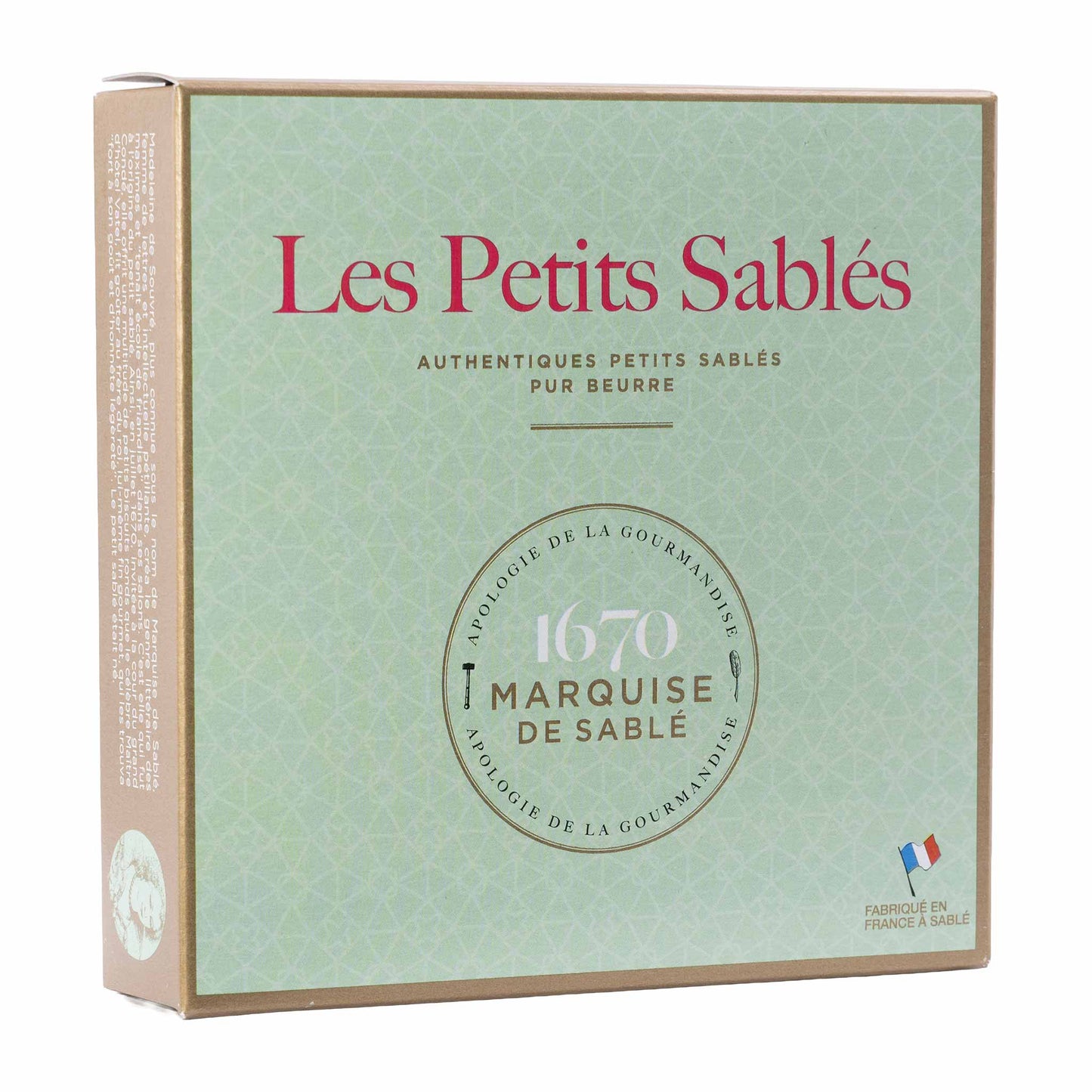
Pure Petit Sablé from Sablé-sur-Sarthe, crumbly and plain
Couldn't load pickup availability


- Excellent Ratings
From 250,000 happy customers - Fast Customer Service
by phone, email, or chat - Family-owned since 2002.
genussland.de: where good taste lives.
Shipping & Delivery
Your order will reach you in just 1–2 days for as little as €5.45 with DHL, DPD, or UPS. Shipping is free for orders over €99. Need it faster? Choose from our express shipping options.

Payment and Installment Plan
Your payment information is always processed securely. Choose from many payment methods such as PayPal, Klarna, Apple Pay, Mastercard or Visa and benefit from purchase on account and payment by installments. You can find more information in our Payment Terms.
Butter Sablés by La Sablésienne. Pure butter, crumbly texture, the Sablé without frills.
La Sablésienne Butter Sablés are the pure Petit Sablé from Sablé-sur-Sarthe — round, fluted, baked from a few ingredients with a high butter content. No chocolate, no fruit pieces, no artificial flavor. The basic tone, not the variation.
La Sablésienne Butter Sablés are the classic French Petit Sablé from the Biscuiterie La Sablésienne in Sablé-sur-Sarthe. They are baked with fresh butter from Pays de la Loire, flour from Sarthois millers, and free-range eggs. The first bite clarifies the matter in two seconds. The biscuit breaks dry and without resistance, crumbling on the tongue into something almost sandy, leaving behind the round, slightly salty taste of good butter. No flavor pushes itself forward, no filling distracts. Anyone who thought a butter biscuit was just a butter biscuit until now will notice the difference right here. It lies solely in what is missing.
Why this biscuit crumbles sandily and doesn't splinter
The Sablé crumbles when bitten instead of splintering. This tender, almost sandy crumb is the defining characteristic of the Petit Sablé and comes from the recipe, not from the oven.
Two ingredients are responsible. 22.7 percent fresh butter surrounds the flour particles during kneading, preventing long gluten strands from forming. Fat inhibits gluten formation. The cornstarch in the dough further dilutes the gluten because it contains no gluten itself and extends the flour content. What is missing is the elasticity that makes dough chewy. What remains is a structure that yields at the first pressure. Sandy is sablé in French — the biscuit carries its texture in its name and shares it with the city from which it originates.
Visually, it is unremarkable: round, about five centimeters, fluted at the edge, pale golden yellow with a hint of a darker rim. In the mouth, it dissolves quickly. It crumbles within two or three seconds into a fine, buttery mass that coats the palate instead of scratching it. Aftertaste: butter, then salt, then nothing.
In taste, the Nature remains deliberately restrained. A moderate sweetness, a pinch of salt, plus a hint of caramel from the crust. Anyone expecting a biscuit with a pronounced flavor of its own, i.e., chocolate, fruit, or spice, will find it too subtle. The Nature is intended as a base note, not an accent.
From milk coffee to cheesecake base
The Nature pairs well with anything that has its own flavor. It never pushes itself into the foreground and therefore works where flavored biscuits would be intrusive.
With espresso or a strong Assam, it's a simple complement: two Sablés, no more needed. With a milk coffee, three are fine. As a crumb base, it's a special case. Calculate 100g of Sablés for an 18cm springform pan, with only about 20g of melted butter. A conventional butter biscuit would need double that amount. The 22.7 percent butter in the biscuit almost solely binds the base. Broken into strips, it replaces the waffle alongside a scoop of vanilla ice cream.
It can also be savory. A Sablé under a piece of aged Comté or a spoonful of fig mustard works like a cracker, but with more depth. On a biscuit platter, it takes on the role of contrast: Next to the cocoa Sablés or the lemon Sablés, it offers the palate a break in between. And dipped into a soft-boiled egg — a habit more admitted than demonstrated in the Sarthe — it surprisingly holds its own for a long time.
Good to know: The 100g are not loosely packed, but divided into four individually sealed portions of four biscuits each. An opened bag should be consumed within two or three days. After that, the biscuit absorbs moisture and loses the dry crumbly texture that defines it. Those expecting a vegan alternative will not find it here: butter and egg are not mere additions, but part of the recipe.
Two recipes, one name, two textures
La Sablésienne bakes the Petit Sablé using two different recipes. The difference between them is greater than their shared name might suggest.
One is simply called Sablé La Sablésienne, the other bears the year 1670 and the name of the Marquise de Sablé. The 1670 recipe contains more butter and more egg, and lacks leavening agents. The biscuit barely rises in the oven and remains flatter. However, the crucial factor is where the egg goes. In the La Sablésienne variation, it is brushed on before baking, browning the surface and making the biscuit crispier. In the 1670 recipe, it goes into the dough, making it more melting. The same ingredient list, two results. Which line is in the box is revealed by the texture more reliably than the label: the more melting biscuit is the 1670.
A second detail is already in the French name. Pur beurre frais means fresh butter, not butterfat. Industrial baked goods usually use concentrated butterfat because it is cheaper, easier to dose, and lasts longer. Fresh butter contains water and milk protein, and it is precisely this that browns in the oven and provides the caramel note at the edges. Butterfat cannot do this. The price difference in procurement is why so few manufacturers stick with it.
The name itself goes back to a summer evening in July 1670. Madeleine de Souvré, Marquise de Sablé, introduced the small round butter pastry at the court of the Grand Condé. The city gave the biscuit its name, and the biscuit later gave it to the Biscuiterie. However, the latter was only founded in 1962, and since 2003, Amélie Loret Scherrer has been running the business. The recipe is now listed as a specialty of French culinary heritage.
The biscuit where the butter cannot hide
A Sablé nature forgives nothing. Where chocolate or fruit might conceal small weaknesses in the dough, the butter stands alone here and is immediately noticeable if it isn't up to par. Six ingredients leave no room for evasion.
This makes the Nature the most honest item in La Sablésienne's range, and also the best introduction. If you want to know what the Biscuiterie can do, try this one first and the flavored varieties afterwards. The square box works well as a gift, especially when you don't know the host's taste. A pure butter sablé offends no one who likes biscuits. Brought to a coffee table or placed as a small greeting alongside a bottle of wine: it needs no occasion, it fills the gap. Four packets also make it shareable if several people are at the table.
Place a box next to the coffee pot on Sunday morning. This biscuit needs no more preparation to assert its place on the table.
La Sablésienne
La Sablésienne
Nutritional Information
Nutritional Information
Alcohol content
Alcohol content
Ingredients
Ingredients
Distributor
Distributor
Legal guarantee
Legal guarantee

How it all began
Does this sound familiar? You return from vacation with a bottle of olive oil from Portugal in your suitcase, a jar of fruit spread from South Tyrol, perhaps a bar of chocolate from a small factory in France — and you ask yourself: Why can't I find something like this easily at home? We kept asking ourselves this question.
We are Kerstin and Stephan Uhlenbusch from Nordhorn, a city on the German-Dutch border. On our travels through Europe, we made the most wonderful culinary discoveries: mountain apple juices from the high altitudes of South Tyrol, Breton barrel butter, handmade pasta from Italy, French sea salt. It wasn't the big luxury products that fascinated us, but rather the honest, artisan-made foods from people who put their heart and soul into their products.
In 2002, we decided to turn this passion into our profession: to make good food accessible to everyone who cannot travel to the producers themselves. This is how our gourmet shipping business came into being — initially as a store in Nordhorn, soon after as one of the first gourmet online shops in Germany. Back then under the name nur Gutes (only good things) — today we continue it as genussland.de. The ambition has remained the same: this is where good taste resides.
Who we are
What drives us is the same curiosity with which we started in 2002: finding out who truly makes good food. Over more than two decades, we have built a network — with producers, traders, restaurateurs, and culinary artisans from all over Europe.
Kerstin was the managing director of the association of leading delicatessen merchants in Germany — the industry association of the country's best owner-managed delicatessen stores. In this role, she not only accompanied but actively shaped the German delicatessen industry. With the deli Festival, we also launched our own B2B trade fair for delicacies, which brought together producers, traders, and restaurateurs from all over Europe. The festival no longer exists today — but the relationships that arose from it still accompany us.
What does this mean for you? We know our industry like almost no one else. Chambers of commerce and economic development agencies from all over Europe repeatedly introduce us to exciting producers who want to offer their products on the German market. This way, genussland always offers something you won't find in any supermarket and hardly in any other shop.
What you'll find here
Our assortment includes fine foods, delicacies, wines, non-alcoholic beverages, and selected kitchen and home accessories — from manufacturers in Germany, Austria, Italy, France, Portugal, Spain, England, Iceland, Denmark, Sweden, Greece, and the USA.
An extra virgin olive oil from Portugal, a genuine Aceto Balsamico from Modena, Fleur de Sel from the Breton coast, hand-mixed spice blends. Fruit spreads, aromatic honey, truffle delicacies, chutneys, and mustard sauces. Vintage sardines and fine canned fish, risotto rice, and handmade pasta — basic ingredients for honest cooking and specialties for special moments.
Our fresh delivery service brings the legendary Beurre Bordier from Brittany, Italian Burrata, and fine salami to your home — securely packaged and continuously chilled.
Wine is particularly close to our hearts: white wine from Rheinhessen and the Pfalz, red wine from Austria and Burgenland, rosé for barbecue season, natural wine for the adventurous, sparkling wine and champagne for special moments. Not from all over the world — but from winemakers we have personally visited and whose work we appreciate. Many of them work organically or biodynamically.
Our Philosophy
What makes a product a genussland product? We ask ourselves this question for every single item we add to our range. The answer is never one-dimensional – it's the combination of craftsmanship, origin, ingredients, and the people behind them.
We ask many questions before a product finds its way into our shop. How is it made? Where do the raw materials come from? What philosophy does the manufacturer pursue? We quickly notice whether we are hearing marketing clichés or if a producer is happy to explain their journey. It is precisely this enthusiasm that we seek – and repeatedly find.
Craftsmanship. We prefer products from small manufactories and family businesses that often produce their culinary treasures by hand for generations. The careful processing and artisanal skill can be tasted in every bite.
Best Ingredients. For us, good quality begins with the raw materials. Whether it's fruit, vegetables, milk, meat, or grain – we ensure that our manufacturers rely on first-class, as natural as possible, ingredients. Many of our producers are organically certified; our shop itself is organically controlled under the number DE-ÖKO-037.
Origin and Regionality. We appreciate products with a clear regional identity. A South Tyrolean mountain apple juice made from slowly ripened, old apple varieties. A Portuguese olive oil from trees that have shaped the landscape for centuries. These stories of origin make delicacies what they are.
Personal relationship with the manufacturer. We have known many of our suppliers personally for years, some for over two decades. We visit them, taste together, and exchange ideas. This proximity guarantees transparency and trust.
At the end of the day, it has to taste good. We try all products ourselves – not just once, but again and again while cooking, at the table, on the plate. Only what convinces us personally finds its way into the shop.
The people behind the products
What brings us the most joy: We get to accompany passionate individuals on their journey. People whose drive it is to make a good product even better. Some have been with us since our founding - for over twenty years.
There's the South Tyrolean fruit farmer who presses mountain apple juice from old, slowly ripened apple varieties, unlike anything else. The Italian balsamic family who ages their vinegar in Modena for decades. The Breton butter manufactory whose hand-churned butter is on the menu of the best restaurants in Europe. The Danish licorice pioneer who reinvented a centuries-old specialty.
Behind every product in our shop stands a person, a family, a story. And it is precisely these stories that make the difference between an interchangeable food item and a true delicacy.
This is where good taste resides
Whether you want to order fine foods online, are looking for a special wine, want to put together a gift for a loved one, or simply want to enrich your kitchen with high-quality ingredients — genussland is the right place for you.
Browse through our assortment, get inspired, and conveniently order your favorite products to your home. Read more about our approach on the Sustainability and Responsibility page. Do you have a question? We look forward to your message to our Customer Service.
Welcome to genussland.
Kerstin and Stephan Uhlenbusch

-
 Vendor:La Sablésienne Biscuiterie Artisanale
Caramel Biscuits
La Sablésienne – Butter Biscuits with Caramel The Caramel Biscuits…
24 in stockRegular price 4,95€Sale price 4,95€ Regular priceUnit price 49,50€ per kg -
 Vendor:La Sablésienne Biscuiterie Artisanale
Lemon Cookies
La Sablésienne Lemon Biscuits - Petit Sablé with lemon from...
37 in stockRegular price 4,95€Sale price 4,95€ Regular priceUnit price 49,50€ per kg -
 Vendor:La Sablésienne Biscuiterie Artisanale
Raspberry Cookies
Butter cookies, with raspberry and rum
23 in stockRegular price 4,95€Sale price 4,95€ Regular priceUnit price 49,50€ per kg -
 Vendor:La Sablésienne Biscuiterie Artisanale
Butter Cookies
Pure Petit Sablé from Sablé-sur-Sarthe, crumbly and plain
17 in stockRegular price 4,95€Sale price 4,95€ Regular priceUnit price 49,50€ per kg -
 Vendor:La Sablésienne Biscuiterie Artisanale
Apricot Cookies
La Sablésienne - Apricot Butter Biscuits The Apricot Biscuits...
24 in stockRegular price 4,95€Sale price 4,95€ Regular priceUnit price 49,50€ per kg -
 Vendor:La Sablésienne Biscuiterie Artisanale
Chocolate Chip Cookies
La Sablésienne – Shortbread with Chocolate Chips The cookies with…
10 in stockRegular price 4,95€Sale price 4,95€ Regular priceUnit price 49,50€ per kg -
 Vendor:La Sablésienne Biscuiterie Artisanale
Tonka Bean Cookies
La Sablésienne – Shortbread with Tonka Bean The Tonka Beans…
19 in stockRegular price 4,95€Sale price 4,95€ Regular priceUnit price 49,50€ per kg -
 Vendor:La Sablésienne Biscuiterie Artisanale
Biscuits with Cocoa
La Sablésienne – Butter Cookies with Cocoa The cocoa cookies from…
9 in stockRegular price 4,95€Sale price 4,95€ Regular priceUnit price 49,50€ per kg -

 NewVendor:La Sablésienne Biscuiterie Artisanale
Sablés Karamell Geschenkdose Bouquet Sauvage
Buttersablés mit Salzbutterkaramell in der Blumendose aus Blech
11 in stockRegular price 16,90€Sale price 16,90€ Regular priceUnit price 96,57€ per kg -
 NewVendor:La Sablésienne Biscuiterie Artisanale
Schokokekse Weihnachten
Kakao-Buttersablés mit Schokostückchen im nachtblauen Weihnachtsetui
24 in stockRegular price 4,95€Sale price 4,95€ Regular priceUnit price 49,50€ per kg


