

Wildflower Honey from Sicily
Cold-spun wildflower honey from the macchia near Trapani
Couldn't load pickup availability
- Excellent Ratings
From 250,000 happy customers - Fast Customer Service
by phone, email, or chat - Family-owned since 2002.
genussland.de: where good taste lives.
Shipping & Delivery
Your order will reach you in just 1–2 days for as little as €5.45 with DHL, DPD, or UPS. Shipping is free for orders over €99. Need it faster? Choose from our express shipping options.

Payment and Installment Plan
Your payment information is always processed securely. Choose from many payment methods such as PayPal, Klarna, Apple Pay, Mastercard or Visa and benefit from purchase on account and payment by installments. You can find more information in our Payment Terms.
Questions about Wildflower Honey from Sicily?
We are happy to help you with Antica Bottega Siciliana.
Wildflower Honey from Sicily. What the Macchia near Trapani yields in a year.
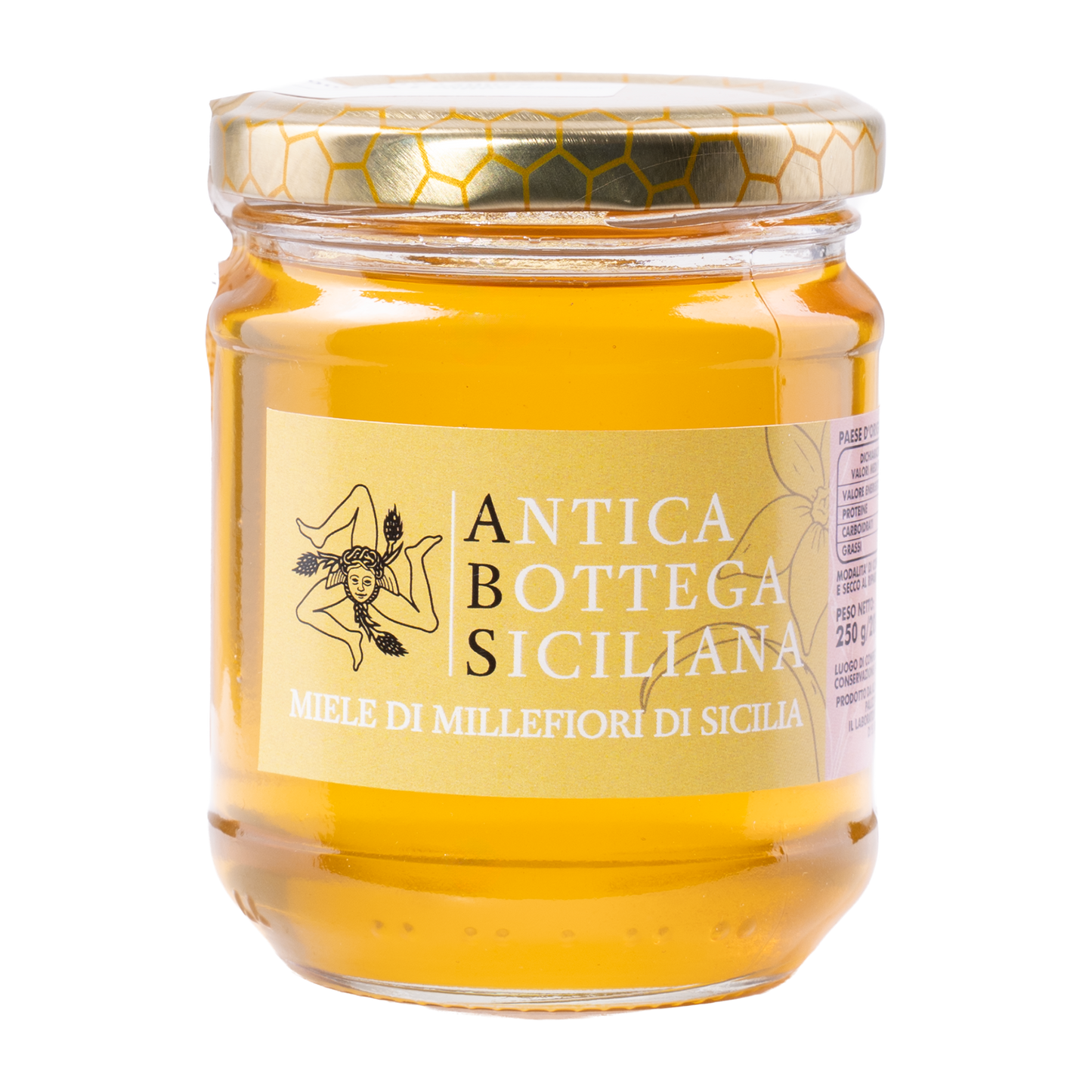
Wildflower honey from Sicily by Antica Bottega Siciliana is a cold-extracted millefiori honey from wild macchia flowers around Trapani. Not a single-varietal honey, not a pasteurized industrial honey, not an anonymous blend from multiple countries of origin.
Wildflower honey from Sicily is a natural millefiori honey from Antica Bottega Siciliana, made from the nectar of wild flowers in the hinterland of Trapani. For wine, the vintage is naturally on the label. For this honey, it would be just as justified.
What goes into the jar is not determined by the beekeeper, but by the year itself. Rain in spring, heat in June, the sequence of blossoms in the bushland. Each harvest captures how this region, between salt flats and hilly country, has bloomed. This makes it the antithesis of all interchangeable breakfast honeys. One spoon is enough to taste the difference.
Amber-colored, mild, and characterized by wild herbs
The wildflower honey glows between golden yellow and light brown, combining gentle sweetness with fine herbal notes. Depending on the harvest year, the shade is lighter or darker. This is also part of its vintage character.
On the nose, this Sicilian honey is floral and warm, with a hint of dried hay. On the palate, it melts smoothly, the sweetness remains round and is never obtrusive. Thistle contributes a subtle bitter edge, wild dill a touch of spice. The Sulla blossom provides its bright, clear basic sweetness underneath.
The finish is clean and medium-long, with a quiet caramel note at the end. In years dominated by herbs, the whole thing appears spicier; in years rich in blossoms, it is softer and more floral. Freshly extracted, the honey flows clear and golden from the spoon. Over the months, it becomes finely granular, solid, and creamy, as unheated honeys do. This does not change the taste, only the texture.
Those looking for the dark power of a chestnut honey or the resinous note of a forest honey will find this honey too gentle. Its strength is its balance. It accompanies rather than dominates, and yet remains more complex than neutral standard goods from the supermarket shelf.
From breakfast bread to aged Pecorino
The balanced sweetness makes this honey a versatile kitchen companion that goes well with both sweet and savory partners. On hearty sourdough bread with cold, salted butter, its herbal note comes through most clearly. Over Greek yogurt with roasted almonds, it replaces any syrup. On the breakfast table, it complements a Sicilian lemon marmalade with a milder, warmer sweetness.
It shows its character with cheese. Half a teaspoon on aged Pecorino or a slightly piquant blue cheese provides a sweet counterpoint. In a dressing, a teaspoon of honey with lemon juice and olive oil replaces sugar. Try it with fennel salad with orange segments. Even a ripe Caciocavallo, the pear-shaped cheese of Southern Italy, gratefully accepts the sweetness. For a quick dessert, mix two tablespoons with 250 g of ricotta and sprinkle chopped pistachios over it. A thin drizzle over warm rice pudding with cinnamon turns leftovers into a Sunday dessert.
It also pairs well with warm cuisine. A tablespoon in the marinade for roasted pumpkin or roasted carrots caramelizes into a savory glaze. On crostini with fresh goat cheese and a few drops of honey, an antipasto that tastes of Sicily is created in ten minutes.
Good to know: Only stir the honey into tea or milk when the drink is lukewarm. Above about 40°C, the delicate floral aromas dissipate, and all that remains is mere sweetness. For recipes that only require neutral sweetness, it is therefore less suitable. For that, it would simply be too precious. The jar should be stored in a dark, dry place at room temperature, where it will keep for years.
Salvatore Novara bundles what small beekeepers harvest
Behind this honey is not a single large beekeeping operation, but Antica Bottega Siciliana, a curated brand from the province of Trapani. It is based in Misiliscemi, between vineyards and the salt flats of the western Sicilian coast. Its founder, Salvatore Novara, lived in Northern France and Rome before returning. His goal: to expand the family business and bring the products of small Sicilian producers to Europe. Novara sees himself less as a merchant than as a curator. He selects, tells the origin, and brings the jars beyond the island. The work is carried out according to traditional rural recipes, deliberately away from industrial processes.
For the honey, this means: The bee colonies of small beekeepers are located in the macchia of the hinterland. There, Sulla, thistle, wild dill, and many spontaneous wildflowers bloom from spring into summer. Which flower provides nectar at any given time is decided by the weather and soil, not a recipe. The technical term for this nectar supply from a landscape is "tracht" (forage). Millefiori, literally "thousand flowers," is the name given in Italy to the polyfloral honey that results from it.
After harvesting, the honey is cold-extracted. This means it leaves the combs at room temperature, solely by centrifugal force, and is not pasteurized. Industrial goods, on the other hand, are often heated to over 70°C to keep them clear and liquid for months. Volatile floral aromas are lost during this treatment. Here, the aroma spectrum of the landscape is preserved, including the natural tendency to crystallize. A water bath at a maximum of 40°C makes it liquid again without losing aromas. The producer also indicates the harvest campaign. So you know which year your jar comes from. And the honey comes from a single region, not from a tank full of country blends. A look at commercial labels shows how rare that has become.
Many forages in one jar instead of a single one
Unlike a single-varietal honey, wildflower honey does not reflect a single flower, but an entire blossoming calendar. The direct comparison with the monofloral Sulla honey from the same house, light and deliberately understated, shows how big the difference is. Between the two lies the difference between a solo voice and a choir: one perfects a single note, the other thrives on the interplay.
You should like one characteristic: the nuances shift from harvest to harvest. Anyone expecting exactly the same taste in every jar is better served with standardized goods. Everyone else receives an honest natural product with origin and vintage character. Those who take the idea further can taste two harvest years side by side, like a small wine tasting.
As a gift for hosts, the 250-gram jar makes a good impression. Also in a gift basket alongside other specialties from Antica Bottega Siciliana or as a sweet component for a cheese evening with friends. A jar that can be given without much occasion and still brings a story with it.
A honey that recounts, year after year, what has bloomed between Trapani and the hilly country — spoonful by spoonful.
Nutritional Information
Nutritional Information
Alcohol content
Alcohol content
Ingredients
Ingredients
Distributor
Distributor
How it all began
Does this sound familiar? You return from vacation with a bottle of olive oil from Portugal in your suitcase, a jar of fruit spread from South Tyrol, perhaps a bar of chocolate from a small factory in France — and you ask yourself: Why can't I find something like this easily at home? We kept asking ourselves this question.
We are Kerstin and Stephan Uhlenbusch from Nordhorn, a city on the German-Dutch border. On our travels through Europe, we made the most wonderful culinary discoveries: mountain apple juices from the high altitudes of South Tyrol, Breton barrel butter, handmade pasta from Italy, French sea salt. It wasn't the big luxury products that fascinated us, but rather the honest, artisan-made foods from people who put their heart and soul into their products.
In 2002, we decided to turn this passion into our profession: to make good food accessible to everyone who cannot travel to the producers themselves. This is how our gourmet shipping business came into being — initially as a store in Nordhorn, soon after as one of the first gourmet online shops in Germany. Back then under the name nur Gutes (only good things) — today we continue it as genussland.de. The ambition has remained the same: this is where good taste resides.
Who we are
What drives us is the same curiosity with which we started in 2002: finding out who truly makes good food. Over more than two decades, we have built a network — with producers, traders, restaurateurs, and culinary artisans from all over Europe.
Kerstin was the managing director of the association of leading delicatessen merchants in Germany — the industry association of the country's best owner-managed delicatessen stores. In this role, she not only accompanied but actively shaped the German delicatessen industry. With the deli Festival, we also launched our own B2B trade fair for delicacies, which brought together producers, traders, and restaurateurs from all over Europe. The festival no longer exists today — but the relationships that arose from it still accompany us.
What does this mean for you? We know our industry like almost no one else. Chambers of commerce and economic development agencies from all over Europe repeatedly introduce us to exciting producers who want to offer their products on the German market. This way, genussland always offers something you won't find in any supermarket and hardly in any other shop.
What you'll find here
Our assortment includes fine foods, delicacies, wines, non-alcoholic beverages, and selected kitchen and home accessories — from manufacturers in Germany, Austria, Italy, France, Portugal, Spain, England, Iceland, Denmark, Sweden, Greece, and the USA.
An extra virgin olive oil from Portugal, a genuine Aceto Balsamico from Modena, Fleur de Sel from the Breton coast, hand-mixed spice blends. Fruit spreads, aromatic honey, truffle delicacies, chutneys, and mustard sauces. Vintage sardines and fine canned fish, risotto rice, and handmade pasta — basic ingredients for honest cooking and specialties for special moments.
Our fresh delivery service brings the legendary Beurre Bordier from Brittany, Italian Burrata, and fine salami to your home — securely packaged and continuously chilled.
Wine is particularly close to our hearts: white wine from Rheinhessen and the Pfalz, red wine from Austria and Burgenland, rosé for barbecue season, natural wine for the adventurous, sparkling wine and champagne for special moments. Not from all over the world — but from winemakers we have personally visited and whose work we appreciate. Many of them work organically or biodynamically.
Our Philosophy
What makes a product a genussland product? We ask ourselves this question for every single item we add to our range. The answer is never one-dimensional – it's the combination of craftsmanship, origin, ingredients, and the people behind them.
We ask many questions before a product finds its way into our shop. How is it made? Where do the raw materials come from? What philosophy does the manufacturer pursue? We quickly notice whether we are hearing marketing clichés or if a producer is happy to explain their journey. It is precisely this enthusiasm that we seek – and repeatedly find.
Craftsmanship. We prefer products from small manufactories and family businesses that often produce their culinary treasures by hand for generations. The careful processing and artisanal skill can be tasted in every bite.
Best Ingredients. For us, good quality begins with the raw materials. Whether it's fruit, vegetables, milk, meat, or grain – we ensure that our manufacturers rely on first-class, as natural as possible, ingredients. Many of our producers are organically certified; our shop itself is organically controlled under the number DE-ÖKO-037.
Origin and Regionality. We appreciate products with a clear regional identity. A South Tyrolean mountain apple juice made from slowly ripened, old apple varieties. A Portuguese olive oil from trees that have shaped the landscape for centuries. These stories of origin make delicacies what they are.
Personal relationship with the manufacturer. We have known many of our suppliers personally for years, some for over two decades. We visit them, taste together, and exchange ideas. This proximity guarantees transparency and trust.
At the end of the day, it has to taste good. We try all products ourselves – not just once, but again and again while cooking, at the table, on the plate. Only what convinces us personally finds its way into the shop.
The people behind the products
What brings us the most joy: We get to accompany passionate individuals on their journey. People whose drive it is to make a good product even better. Some have been with us since our founding - for over twenty years.
There's the South Tyrolean fruit farmer who presses mountain apple juice from old, slowly ripened apple varieties, unlike anything else. The Italian balsamic family who ages their vinegar in Modena for decades. The Breton butter manufactory whose hand-churned butter is on the menu of the best restaurants in Europe. The Danish licorice pioneer who reinvented a centuries-old specialty.
Behind every product in our shop stands a person, a family, a story. And it is precisely these stories that make the difference between an interchangeable food item and a true delicacy.
This is where good taste resides
Whether you want to order fine foods online, are looking for a special wine, want to put together a gift for a loved one, or simply want to enrich your kitchen with high-quality ingredients — genussland is the right place for you.
Browse through our assortment, get inspired, and conveniently order your favorite products to your home. Read more about our approach on the Sustainability and Responsibility page. Do you have a question? We look forward to your message to our Customer Service.
Welcome to genussland.
Kerstin and Stephan Uhlenbusch


