

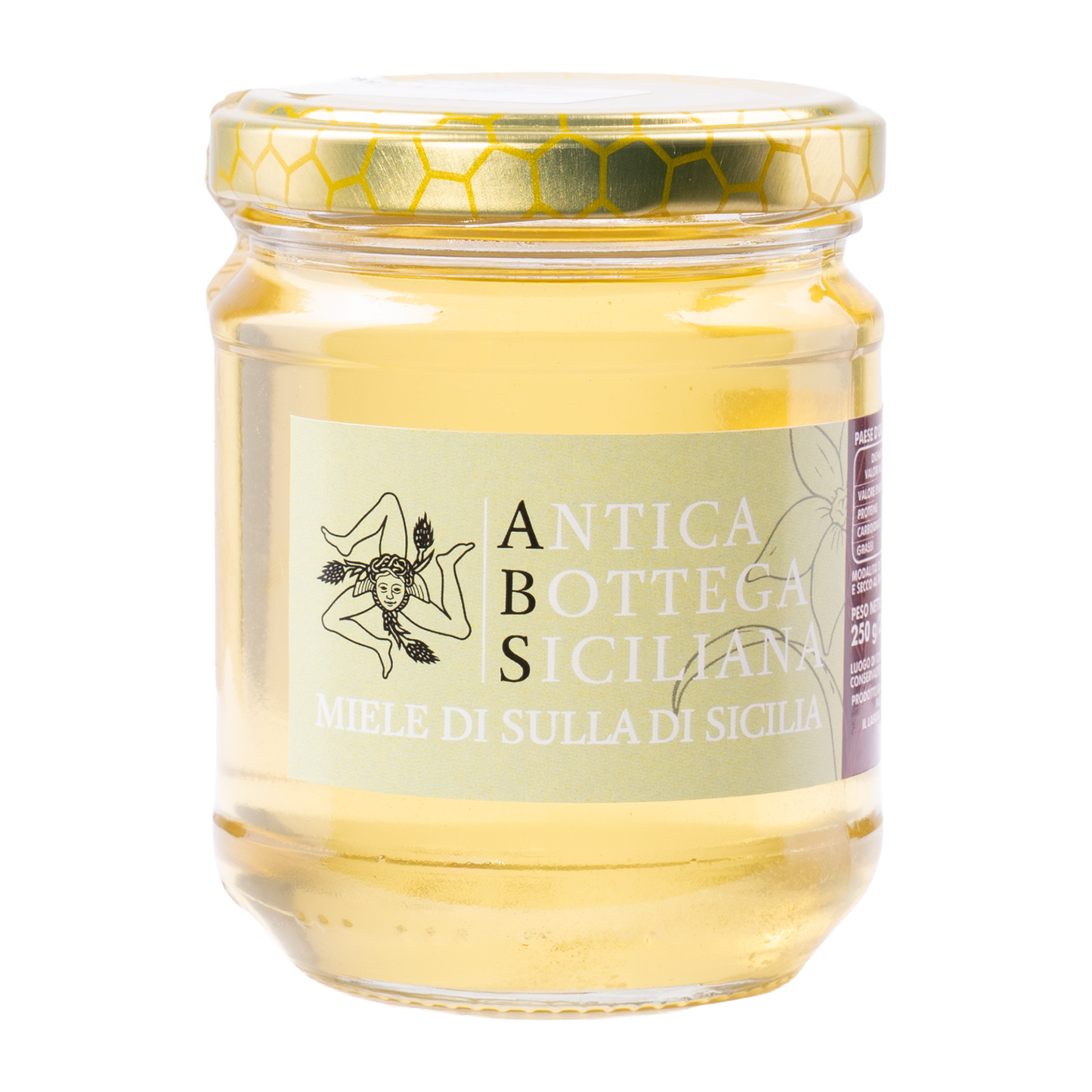
Sulla honey from Sicily
Mild varietal honey from sweet clover blossoms in Western Sicily
Couldn't load pickup availability
- Excellent Ratings
From 250,000 happy customers - Fast Customer Service
by phone, email, or chat - Family-owned since 2002.
genussland.de: where good taste lives.
Shipping & Delivery
Your order will reach you in just 1–2 days for as little as €5.45 with DHL, DPD, or UPS. Shipping is free for orders over €99. Need it faster? Choose from our express shipping options.

Payment and Installment Plan
Your payment information is always processed securely. Choose from many payment methods such as PayPal, Klarna, Apple Pay, Mastercard or Visa and benefit from purchase on account and payment by installments. You can find more information in our Payment Terms.
Sulla Honey from Sicily. A quiet blossom honey from a loud island.
Sulla honey from Sicily is a light, mild varietal honey from the spring blossoms of sulla clover around Trapani. Not a dark, spiced honey, not a flavored honey preparation, no anonymous large-scale bottling — but pure floral nectar from Western Sicily.
Sulla honey from Sicily is a single-varietal blossom honey from Antica Bottega Siciliana, harvested from the purple-red blossoms of sulla clover. Sicily is associated with intensity: blood oranges, capers, sea salt, dark roasted espresso. Yet, it is precisely here, between the salt pans of Trapani and the hills of the hinterland, that one of Italy's mildest honeys is produced. It pours off the spoon in a light golden hue, its fragrance subtle, its sweetness clear and soft. Those expecting the taste of the south in a jar will find spring instead. This contradiction is no coincidence — it's botany. And it makes this jar a quiet exception on the shelf of varietal honeys.
Sicilian honey can be this mild
Sulla honey is one of the lightest and mildest varietal honeys in the Mediterranean region: delicate sweetness, fine floral notes, a clean finish without bitterness. In the jar, it appears straw-gold to ivory, depending on the age of the batch. The aroma carries wildflowers, a hint of fresh hay, and a green herbal note. Hold the jar up to the light: fresh batches glow like pale amber, older ones become opaque and delicately pastel yellow.
On the palate, a soft, clear sweetness unfolds — almost without acidity, entirely without sharpness. The finish remains short and clean; nothing lingers, nothing irritates. It shares its mildness with acacia honey, but brings significantly more floral character than acacia's neutral sweetness. Its sugar profile contains more fructose than glucose. Therefore, the honey remains liquid for months after extraction before finely and creamily crystallizing. When liquid, it feels silky on the tongue; when crystallized, it spreads like soft butter. Both states are snapshots of the same natural honey — no difference in quality, just time.
This mildness has a downside. Those seeking the robust intensity of chestnut honey or the dark spice of forest honey will find sulla too quiet. It is also unsuitable as a distinctive counterpart to blue cheese — it lacks the punch. It is a nuance, not a statement — and precisely designed for that.
From the breakfast table to the cheese board
Mild honey works best where it doesn't have to contend with strong flavors — that's exactly how you use sulla. In the morning, a teaspoon over Greek yogurt with toasted almonds and a little cinnamon is enough. On sourdough bread with salted butter, three ingredients create a small dessert. Alongside an orange marmalade from Sicily, it complements the breakfast table without competing with it.
For a cheese platter, serve it with young Pecorino, Primo Sale, or mild fresh goat cheese. The delicate sweetness enhances the saltiness of the cheese without overpowering its inherent flavor. For a citrus dressing, mix one teaspoon of sulla honey with three tablespoons of olive oil and the juice of half a lemon. The result pairs well with fennel salad with orange segments, a classic of Western Sicilian cuisine. Over vanilla ice cream with salted pistachios, a spoonful of this honey replaces any dessert sauce. Its floral note also holds its own with warm goat cheese or crêpes with lemon zest. It also works well in drinks, as long as the liquid is only lukewarm. A teaspoon in lukewarm almond milk or mild white tea sweetens without masking the drink's character.
Good to know: For cheese, the rule of thumb is: mild honey for young cheese, strong honey for long-aged cheese. For two-year-aged Pecorino or dark marinades, a stronger Sicilian wildflower honey is more suitable. Sulla is also less suitable for baking — oven heat robs it of its floral notes, leaving pure sweetness. Use it where its aroma remains intact: cold, lukewarm, or as a finishing touch.
Why sulla honey is almost exclusively found in the south
Sulla, botanically Sulla coronaria, grows on the heavy limestone and clay soils of the Mediterranean region — it is rarely found north of central Italy. In Sicily, it covers entire hillsides with purple-red flower spikes from April to June. Between the coastal salt pans and the vineyards of the hinterland, bees find a short, abundant supply of nectar. Farmers have sown this legume as fodder for centuries, as its roots fix nitrogen and invigorate lean soils. The fact that its nectar-rich blossoms also serve as bee pasture is the more enjoyable part of this story. With the decline of traditional fodder cultivation, pure sulla fields have become rarer — and with them, this honey.
Single-varietal honey is only produced with precise timing. Beekeepers place their colonies directly next to the flowering sulla fields and extract the honey immediately after the end of the bloom. "Tracht" refers to the nectar supply of a plant species during its flowering — for sulla, this is only a few weeks. If harvested too late, other blossoms mix in, and the varietal purity is lost. Sulla is therefore part of the beekeepers' spring harvest, extracted long before chestnut and eucalyptus.
Behind the jar is not a honey corporation, but a curatorial project from Trapani. Founder Salvatore Novara worked for a long time on the Italian mainland and in France before returning to his hometown. Today, he selects from small producers in Western Sicily what is created according to traditional peasant recipes and methods. The sulla honey comes from this selection: small batches instead of industrial scale, a beekeeper's product with a clear origin. For you, this means: every jar bears the signature of an apiary, not the average of a tank farm.
Origin in the jar instead of a mix from all over the world
Many honeys in stores are blends from several countries — this one comes from one blossom, one region, one season. A glance at common labels often shows the designation "blend of honey from EU and non-EU countries". With Antica Bottega Siciliana's sulla, however, the origin can be narrowed down to Western Sicily. The 250-gram jar remains deliberately small: single-varietal honey from a short bloom is not available in arbitrary quantities. If a harvest is sold out, new stock will only arrive with the next bloom in spring.
As a gift, it replaces the usual bottle of wine — more personal, longer-lasting, and also suitable for hosts who don't drink alcohol. It accompanies thanks to hosts as well as a gourmet package for a birthday or housewarming. For a Sicilian breakfast in a basket, combine it with other specialties from the Antica Bottega Siciliana collection. A honey to give as a gift to people who appreciate subtlety — and to keep if you are one of them.
A quiet jar from Western Sicily — for all who appreciate honey as a fine nuance and not as a grand gesture.
Nutritional Information
Nutritional Information
Alcohol content
Alcohol content
Ingredients
Ingredients
Distributor
Distributor
Legal guarantee
Legal guarantee

How it all began
Does this sound familiar? You return from vacation with a bottle of olive oil from Portugal in your suitcase, a jar of fruit spread from South Tyrol, perhaps a bar of chocolate from a small factory in France — and you ask yourself: Why can't I find something like this easily at home? We kept asking ourselves this question.
We are Kerstin and Stephan Uhlenbusch from Nordhorn, a city on the German-Dutch border. On our travels through Europe, we made the most wonderful culinary discoveries: mountain apple juices from the high altitudes of South Tyrol, Breton barrel butter, handmade pasta from Italy, French sea salt. It wasn't the big luxury products that fascinated us, but rather the honest, artisan-made foods from people who put their heart and soul into their products.
In 2002, we decided to turn this passion into our profession: to make good food accessible to everyone who cannot travel to the producers themselves. This is how our gourmet shipping business came into being — initially as a store in Nordhorn, soon after as one of the first gourmet online shops in Germany. Back then under the name nur Gutes (only good things) — today we continue it as genussland.de. The ambition has remained the same: this is where good taste resides.
Who we are
What drives us is the same curiosity with which we started in 2002: finding out who truly makes good food. Over more than two decades, we have built a network — with producers, traders, restaurateurs, and culinary artisans from all over Europe.
Kerstin was the managing director of the association of leading delicatessen merchants in Germany — the industry association of the country's best owner-managed delicatessen stores. In this role, she not only accompanied but actively shaped the German delicatessen industry. With the deli Festival, we also launched our own B2B trade fair for delicacies, which brought together producers, traders, and restaurateurs from all over Europe. The festival no longer exists today — but the relationships that arose from it still accompany us.
What does this mean for you? We know our industry like almost no one else. Chambers of commerce and economic development agencies from all over Europe repeatedly introduce us to exciting producers who want to offer their products on the German market. This way, genussland always offers something you won't find in any supermarket and hardly in any other shop.
What you'll find here
Our assortment includes fine foods, delicacies, wines, non-alcoholic beverages, and selected kitchen and home accessories — from manufacturers in Germany, Austria, Italy, France, Portugal, Spain, England, Iceland, Denmark, Sweden, Greece, and the USA.
An extra virgin olive oil from Portugal, a genuine Aceto Balsamico from Modena, Fleur de Sel from the Breton coast, hand-mixed spice blends. Fruit spreads, aromatic honey, truffle delicacies, chutneys, and mustard sauces. Vintage sardines and fine canned fish, risotto rice, and handmade pasta — basic ingredients for honest cooking and specialties for special moments.
Our fresh delivery service brings the legendary Beurre Bordier from Brittany, Italian Burrata, and fine salami to your home — securely packaged and continuously chilled.
Wine is particularly close to our hearts: white wine from Rheinhessen and the Pfalz, red wine from Austria and Burgenland, rosé for barbecue season, natural wine for the adventurous, sparkling wine and champagne for special moments. Not from all over the world — but from winemakers we have personally visited and whose work we appreciate. Many of them work organically or biodynamically.
Our Philosophy
What makes a product a genussland product? We ask ourselves this question for every single item we add to our range. The answer is never one-dimensional – it's the combination of craftsmanship, origin, ingredients, and the people behind them.
We ask many questions before a product finds its way into our shop. How is it made? Where do the raw materials come from? What philosophy does the manufacturer pursue? We quickly notice whether we are hearing marketing clichés or if a producer is happy to explain their journey. It is precisely this enthusiasm that we seek – and repeatedly find.
Craftsmanship. We prefer products from small manufactories and family businesses that often produce their culinary treasures by hand for generations. The careful processing and artisanal skill can be tasted in every bite.
Best Ingredients. For us, good quality begins with the raw materials. Whether it's fruit, vegetables, milk, meat, or grain – we ensure that our manufacturers rely on first-class, as natural as possible, ingredients. Many of our producers are organically certified; our shop itself is organically controlled under the number DE-ÖKO-037.
Origin and Regionality. We appreciate products with a clear regional identity. A South Tyrolean mountain apple juice made from slowly ripened, old apple varieties. A Portuguese olive oil from trees that have shaped the landscape for centuries. These stories of origin make delicacies what they are.
Personal relationship with the manufacturer. We have known many of our suppliers personally for years, some for over two decades. We visit them, taste together, and exchange ideas. This proximity guarantees transparency and trust.
At the end of the day, it has to taste good. We try all products ourselves – not just once, but again and again while cooking, at the table, on the plate. Only what convinces us personally finds its way into the shop.
The people behind the products
What brings us the most joy: We get to accompany passionate individuals on their journey. People whose drive it is to make a good product even better. Some have been with us since our founding - for over twenty years.
There's the South Tyrolean fruit farmer who presses mountain apple juice from old, slowly ripened apple varieties, unlike anything else. The Italian balsamic family who ages their vinegar in Modena for decades. The Breton butter manufactory whose hand-churned butter is on the menu of the best restaurants in Europe. The Danish licorice pioneer who reinvented a centuries-old specialty.
Behind every product in our shop stands a person, a family, a story. And it is precisely these stories that make the difference between an interchangeable food item and a true delicacy.
This is where good taste resides
Whether you want to order fine foods online, are looking for a special wine, want to put together a gift for a loved one, or simply want to enrich your kitchen with high-quality ingredients — genussland is the right place for you.
Browse through our assortment, get inspired, and conveniently order your favorite products to your home. Read more about our approach on the Sustainability and Responsibility page. Do you have a question? We look forward to your message to our Customer Service.
Welcome to genussland.
Kerstin and Stephan Uhlenbusch


