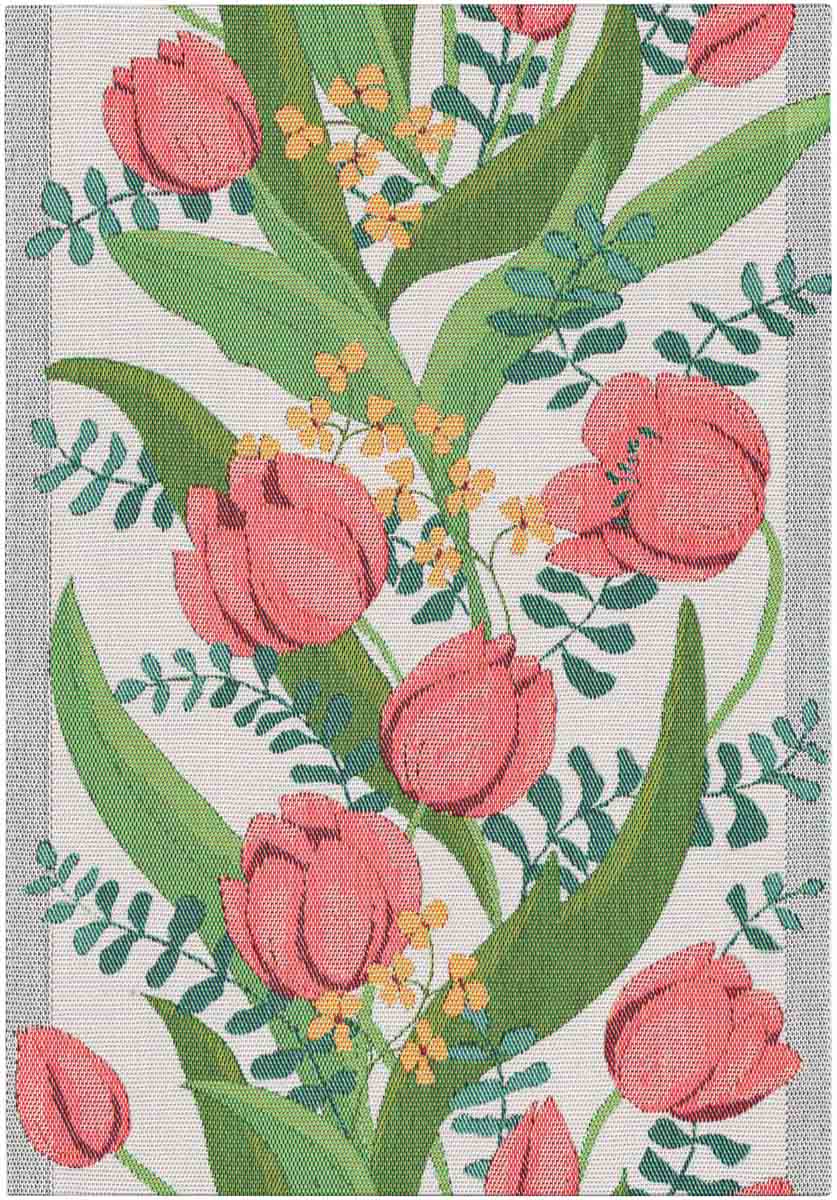
Tulpanlund Towel. Woven tulips, organic cotton, Swedish weaving mill.
The Tulpanlund towel is a kitchen towel woven in Sweden from organic cotton, with a tulip motif that is not printed but rather integrated into the fabric. Not terry cloth, not a bath towel, not purely decorative.
The Tulpanlund towel is a dish towel from the Swedish weaving mill Ekelund, bringing together pink tulips, yellow blossoms, and eucalyptus green on 35 by 50 centimeters. In the kitchen, such a towel usually hangs on a hook next to the stove, and that's precisely where its usefulness is decided. Tulpanlund catches the eye before it's even used. When you pick it up, the grip is surprising: firmer than expected, with a noticeable texture instead of a smooth surface.
Why woven tulips have a different effect than printed ones
The motif is created on the loom, not in the printing press. The colored threads run through the entire fabric, which is why the tulips appear mirrored but complete on the reverse side. This manufacturing method explains the color effect: pink, yellow, and green stand side by side, without the harsh edges of a print.
This gives the surface a slightly relief-like feel. Cotton threads in different colors create a structure that absorbs water well and leaves no lint when drying glass. New towels are initially a little stiffer. The absorbency increases significantly after the first few washes as the fibers stand up.
Those expecting a photorealistic floral motif in glossy colors will find Tulpanlund too understated. Woven patterns are inevitably flatter and softer in color than printed ones. What they gain, however, is that the motif does not fade, because there is no layer of color that could wash off. After fifty washes, a woven towel still looks similar to its first day.
For glass, for herbs, for the laid table
At 35 by 50 centimeters, Tulpanlund is one of the smaller formats. It is designed for dishes, not for large pots or roasting pans. For wine glasses, this is precisely an advantage.
The cloth can be folded and inserted into the bowl without getting stuck. Anyone who has ever broken a glass stem while polishing knows the difference between a handy and an overly voluminous cloth.
Three uses beyond drying have proven successful. First: Wrap freshly washed herbs in it and store them in the vegetable drawer. This keeps parsley and coriander firm for two to three days longer. Second: As a liner in the bread basket, where the woven structure catches crumbs and can then be shaken out. Third: Placed over a bowl of rising yeast dough, because cotton regulates moisture without drying out the dough. A dish towel completely replaces cling film here.
The motif is not available in other formats. If you want to set the table to match, combine it with the wildflower motifs from the same weaving mill or a placemat with poppies.
Good to know: Wash the towel at 40 degrees without fabric softener before first use. Fabric softener forms a film on the fibers and noticeably reduces absorbency. Washing up to 60 degrees is unproblematic. A dryer is possible, but shortens the lifespan and can shrink pure cotton by up to three percent.
A weaving mill that has been doing the same thing since 1692
Ekelund weaves in Sweden and is one of the oldest family-run textile businesses in the world. The lineage dates back to 1692, and for centuries the house supplied the Swedish royal court.
This origin explains the choice of motifs. Tulips, wildflowers, Dala horses, and archipelago landscapes come from the vocabulary of Swedish folk art, not from international design studios. A tulip motif means something different in Scandinavia than in Central Europe: It marks the end of a winter that in Västergötland lasts until April.
Technically, the weaving mill works with Jacquard looms. In this process, each warp thread is individually controlled, allowing for arbitrarily complex patterns to be depicted directly in the fabric. A printed cloth is created in seconds, a Jacquard-woven one much slower, because the pattern grows row by row. The effort is the reason for the price difference to yard goods from a department store.
The cotton comes from organic farming and is GOTS certified. The Global Organic Textile Standard includes not only the fiber but also dyeing processes and working conditions. For a kitchen towel that is washed weekly and comes into contact with food, the origin of the dyes is not a minor aspect.
A spring motif that is not just for Easter
Tulpanlund remains subtle enough in color not to look like seasonal goods. Pink and eucalyptus green work in a bright kitchen all year round, while pronounced Easter motifs with bunnies and eggs disappear into the cupboard by May at the latest.
As a souvenir, the towel is better than usual hostess gifts, because it is used and still represents something. Together with a jar of jam or a bottle of olive oil, it creates a gift that does not look like a makeshift solution.
One limitation remains: the motif is distinctly spring-like. In a consistently dark kitchen with black fronts, it appears out of place. There, the Ekelund motifs on a black background are the better choice.
A kitchen towel that you hang up because you want to see it, and use because it does its job.