

Cocoa Confection with Hazelnut Crunch
Powdered Fantaisie Truffles with Caramelized Hazelnut, 16 pieces
Couldn't load pickup availability


- Excellent Ratings
From 250,000 happy customers - Fast Customer Service
by phone, email, or chat - Family-owned since 2002.
genussland.de: where good taste lives.
Shipping & Delivery
Your order will reach you in just 1–2 days for as little as €5.45 with DHL, DPD, or UPS. Shipping is free for orders over €99. Need it faster? Choose from our express shipping options.

Payment and Installment Plan
Your payment information is always processed securely. Choose from many payment methods such as PayPal, Klarna, Apple Pay, Mastercard or Visa and benefit from purchase on account and payment by installments. You can find more information in our Payment Terms.
Cocoa Confectionery with Hazelnut Crunch. Powdery Cocoa Truffle from Alsace with Caramelized Nut.
Cocoa Confectionery with Hazelnut Crunch is a French cocoa truffle from Chocolaterie Bruntz, 16 pieces per box, rolled in dark cocoa powder on the outside. Not a filled praline, no bar, no nougat.
Cocoa Confectionery with Hazelnut Crunch is a Truffes Fantaisie from Chocolaterie Bruntz in Kingersheim, Alsace. When you open the box, you initially expect a solid chocolate shell. Instead, you'll find matte, irregularly shaped truffles in dark cocoa powder. The mass yields slightly even between your fingers. It crumbles in your mouth, then the caramelized hazelnut crunches. This sequence is the whole character of the product.
Why this truffle tastes dry at first
The first impression is tart and bone-dry, as there's pure cocoa powder without sugar on the outside. Only then does the core open up. It tastes of dark cocoa, cooked cream, and milk sugar. Finally, roasted caramel from the hazelnut splinters emerges. These splinters make up six percent of the mass and remain crunchy until the last bite. They are coarse enough to be noticeable, and fine enough not to get stuck between your teeth. The texture is significantly softer than what you're used to from classic pralines. The core works without cocoa butter, instead binding vegetable fat from copra and palm kernel. This fat melts at around 24 degrees Celsius, well below body temperature. This is precisely why it crumbles on the tongue without sticking to the palate. If you expect a strict, bitter cocoa tone like a single-origin bar with 70 percent, you'll find the truffle too milky. Truffes Fantaisie are sweet, creamy, and soft. They are closer to confectionery than to dark chocolate bars, and that's precisely their appeal. The aftertaste is short and clean, making a second truffle easier than planned.
The hazelnut never takes the lead. It adds accents, while the cocoa and milk notes maintain the framework. If you're looking for a dominant nut filling like in a Gianduja praline, you'll find less nut here than the name suggests. Six percent is a deliberate dosage: enough for texture, too little for a pure nut product.
Two pieces with espresso, that's all it takes
A strong espresso is the most obvious partner because the bitterness reduces the sweetness of the core. Two truffles are enough for a coffee break, so the box lasts well over a week. For dessert, serve three pieces per person on a small plate, along with a glass of dry Crémant. The fine perlage removes the fat film and frees the palate for the next bite. For a hazelnut tasting, place the Giandujotto from Piedmont next to it: one firm and sliceable, the other powdery and soft. Two countries, one nut, two completely different textures. If you're looking for the French classic in a direct comparison, grab the Truffes Fantaisie in a ballotin. Crumble two truffles over a scoop of vanilla ice cream, and the cocoa powder will spread like coarse sprinkles. This confectionery has no place on a cheese board, however; it's too sweet for that. It's also not suitable for baking, as the mass simply runs out in the oven.
On an etagere next to pastries, however, the box makes a good impression. Place the truffles individually there, not in a heap, otherwise they will rub off their cocoa powder on each other. For afternoon tea, a strong Assam is better suited than a delicate Darjeeling, as it picks up the milk note in the core.
Our tip: Take the box out of the cool room half an hour before serving. At 18 degrees Celsius, the core reveals its full melt. Directly from the refrigerator, it appears dull, and the powder draws moisture from the air.
Kingersheim, 1960, and a truffle in Kougelhopf shape
Three brothers named Bruntz founded a Chocolaterie in Kingersheim, north of Mulhouse, in 1960. Since 1978, the company has been operating on Rue de l'Industrie, now with about ten employees. In 2005, the Ricou family took over, and in 2024, the parents passed it on to Quentin Ricou and Laurent Kalis. The business became famous in the 1980s with an unusual idea: Truffes Fantaisie in the ribbed shape of the Alsatian Kougelhopf. These Kougelhopf truffles are still the house's signature and the reason why Bruntz is known far beyond Alsace. The genre itself is older. Since the 1930s, France has been stirring vegetable fat, sugar, low-fat cocoa powder, and whey powder into a mass, shaping it, and rolling it in cocoa. The renunciation of cocoa butter was originally a matter of price, but became a characteristic of its own confectionery genre. Because cocoa butter is absent, the result cannot be called chocolate in Germany, but rather cocoa confectionery. The name sounds sober and accurately describes what is in the box. Bruntz adds caramelized hazelnut splinters, which have been previously coated with sugar, to this basic mass. As a partner of the Marque Alsace, the company is officially allowed to state its origin on the packaging.
The manufacturing process itself remains manageable. The mass is tempered, portioned, shaped, and then rolled in cocoa powder before being hand-packed into boxes. Ten employees mean short distances between cauldron and carton. In addition to truffles, dragées and hand-poured chocolate figures are produced in Kingersheim, which determine the company's annual cycle. The cocoa confectionery, however, runs all year round and is the constant of the house.
A box that is already wrapped
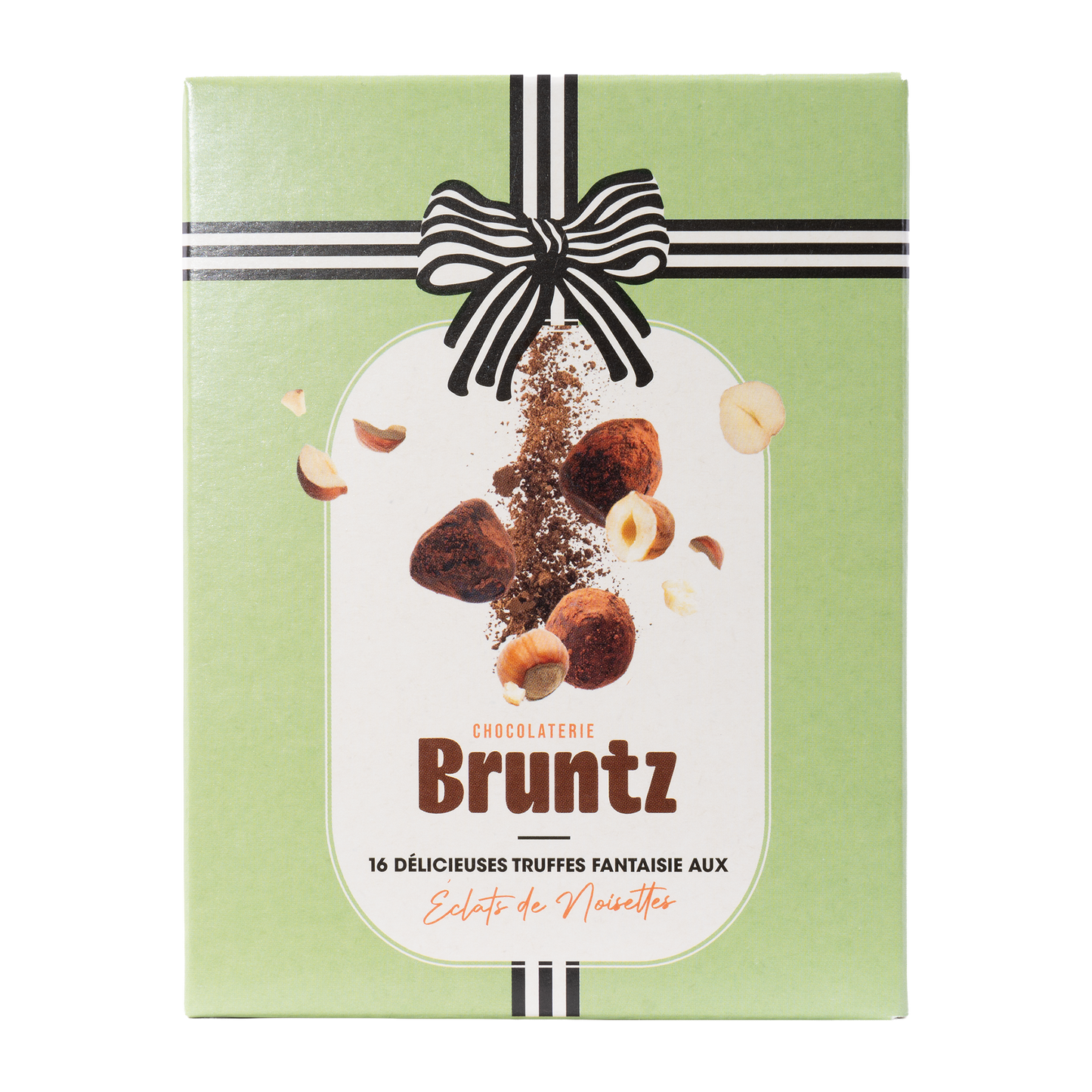
The green box has a printed black and white ribbon with a bow and doesn't need gift wrapping. 100 grams, 16 truffles, a format between a small gift and a supply. It works just as well as a small gesture for dinner as it does as a reserve in a desk drawer. Three varieties stand side by side, and if you take all three, you have an assortment from a single house in your bag. For large gatherings, however, one box will not go far. Plan for three to four pieces per guest; then you'll need a second pack for five people or more. The confectionery is not suitable for shipping on a hot summer day, as the core melts too early.
As a guest gift, the box has a practical advantage: it stands upright, can be stacked, and survives a handbag without damage. To conclude a meal, simply place the open box on the table instead of setting individual plates. This takes away the formality of dessert and invites people to help themselves.
One last note on quantity: 16 truffles seem like a lot, but they disappear quickly. If you're trying the variety for the first time, it makes sense to get two boxes right away.
A truffle for those who value melt higher than cocoa content.
Nutritional Information
Nutritional Information
Alcohol content
Alcohol content
Ingredients
Ingredients
Distributor
Distributor
Legal guarantee
Legal guarantee

How it all began
Does this sound familiar? You return from vacation with a bottle of olive oil from Portugal in your suitcase, a jar of fruit spread from South Tyrol, perhaps a bar of chocolate from a small factory in France — and you ask yourself: Why can't I find something like this easily at home? We kept asking ourselves this question.
We are Kerstin and Stephan Uhlenbusch from Nordhorn, a city on the German-Dutch border. On our travels through Europe, we made the most wonderful culinary discoveries: mountain apple juices from the high altitudes of South Tyrol, Breton barrel butter, handmade pasta from Italy, French sea salt. It wasn't the big luxury products that fascinated us, but rather the honest, artisan-made foods from people who put their heart and soul into their products.
In 2002, we decided to turn this passion into our profession: to make good food accessible to everyone who cannot travel to the producers themselves. This is how our gourmet shipping business came into being — initially as a store in Nordhorn, soon after as one of the first gourmet online shops in Germany. Back then under the name nur Gutes (only good things) — today we continue it as genussland.de. The ambition has remained the same: this is where good taste resides.
Who we are
What drives us is the same curiosity with which we started in 2002: finding out who truly makes good food. Over more than two decades, we have built a network — with producers, traders, restaurateurs, and culinary artisans from all over Europe.
Kerstin was the managing director of the association of leading delicatessen merchants in Germany — the industry association of the country's best owner-managed delicatessen stores. In this role, she not only accompanied but actively shaped the German delicatessen industry. With the deli Festival, we also launched our own B2B trade fair for delicacies, which brought together producers, traders, and restaurateurs from all over Europe. The festival no longer exists today — but the relationships that arose from it still accompany us.
What does this mean for you? We know our industry like almost no one else. Chambers of commerce and economic development agencies from all over Europe repeatedly introduce us to exciting producers who want to offer their products on the German market. This way, genussland always offers something you won't find in any supermarket and hardly in any other shop.
What you'll find here
Our assortment includes fine foods, delicacies, wines, non-alcoholic beverages, and selected kitchen and home accessories — from manufacturers in Germany, Austria, Italy, France, Portugal, Spain, England, Iceland, Denmark, Sweden, Greece, and the USA.
An extra virgin olive oil from Portugal, a genuine Aceto Balsamico from Modena, Fleur de Sel from the Breton coast, hand-mixed spice blends. Fruit spreads, aromatic honey, truffle delicacies, chutneys, and mustard sauces. Vintage sardines and fine canned fish, risotto rice, and handmade pasta — basic ingredients for honest cooking and specialties for special moments.
Our fresh delivery service brings the legendary Beurre Bordier from Brittany, Italian Burrata, and fine salami to your home — securely packaged and continuously chilled.
Wine is particularly close to our hearts: white wine from Rheinhessen and the Pfalz, red wine from Austria and Burgenland, rosé for barbecue season, natural wine for the adventurous, sparkling wine and champagne for special moments. Not from all over the world — but from winemakers we have personally visited and whose work we appreciate. Many of them work organically or biodynamically.
Our Philosophy
What makes a product a genussland product? We ask ourselves this question for every single item we add to our range. The answer is never one-dimensional – it's the combination of craftsmanship, origin, ingredients, and the people behind them.
We ask many questions before a product finds its way into our shop. How is it made? Where do the raw materials come from? What philosophy does the manufacturer pursue? We quickly notice whether we are hearing marketing clichés or if a producer is happy to explain their journey. It is precisely this enthusiasm that we seek – and repeatedly find.
Craftsmanship. We prefer products from small manufactories and family businesses that often produce their culinary treasures by hand for generations. The careful processing and artisanal skill can be tasted in every bite.
Best Ingredients. For us, good quality begins with the raw materials. Whether it's fruit, vegetables, milk, meat, or grain – we ensure that our manufacturers rely on first-class, as natural as possible, ingredients. Many of our producers are organically certified; our shop itself is organically controlled under the number DE-ÖKO-037.
Origin and Regionality. We appreciate products with a clear regional identity. A South Tyrolean mountain apple juice made from slowly ripened, old apple varieties. A Portuguese olive oil from trees that have shaped the landscape for centuries. These stories of origin make delicacies what they are.
Personal relationship with the manufacturer. We have known many of our suppliers personally for years, some for over two decades. We visit them, taste together, and exchange ideas. This proximity guarantees transparency and trust.
At the end of the day, it has to taste good. We try all products ourselves – not just once, but again and again while cooking, at the table, on the plate. Only what convinces us personally finds its way into the shop.
The people behind the products
What brings us the most joy: We get to accompany passionate individuals on their journey. People whose drive it is to make a good product even better. Some have been with us since our founding - for over twenty years.
There's the South Tyrolean fruit farmer who presses mountain apple juice from old, slowly ripened apple varieties, unlike anything else. The Italian balsamic family who ages their vinegar in Modena for decades. The Breton butter manufactory whose hand-churned butter is on the menu of the best restaurants in Europe. The Danish licorice pioneer who reinvented a centuries-old specialty.
Behind every product in our shop stands a person, a family, a story. And it is precisely these stories that make the difference between an interchangeable food item and a true delicacy.
This is where good taste resides
Whether you want to order fine foods online, are looking for a special wine, want to put together a gift for a loved one, or simply want to enrich your kitchen with high-quality ingredients — genussland is the right place for you.
Browse through our assortment, get inspired, and conveniently order your favorite products to your home. Read more about our approach on the Sustainability and Responsibility page. Do you have a question? We look forward to your message to our Customer Service.
Welcome to genussland.
Kerstin and Stephan Uhlenbusch


