


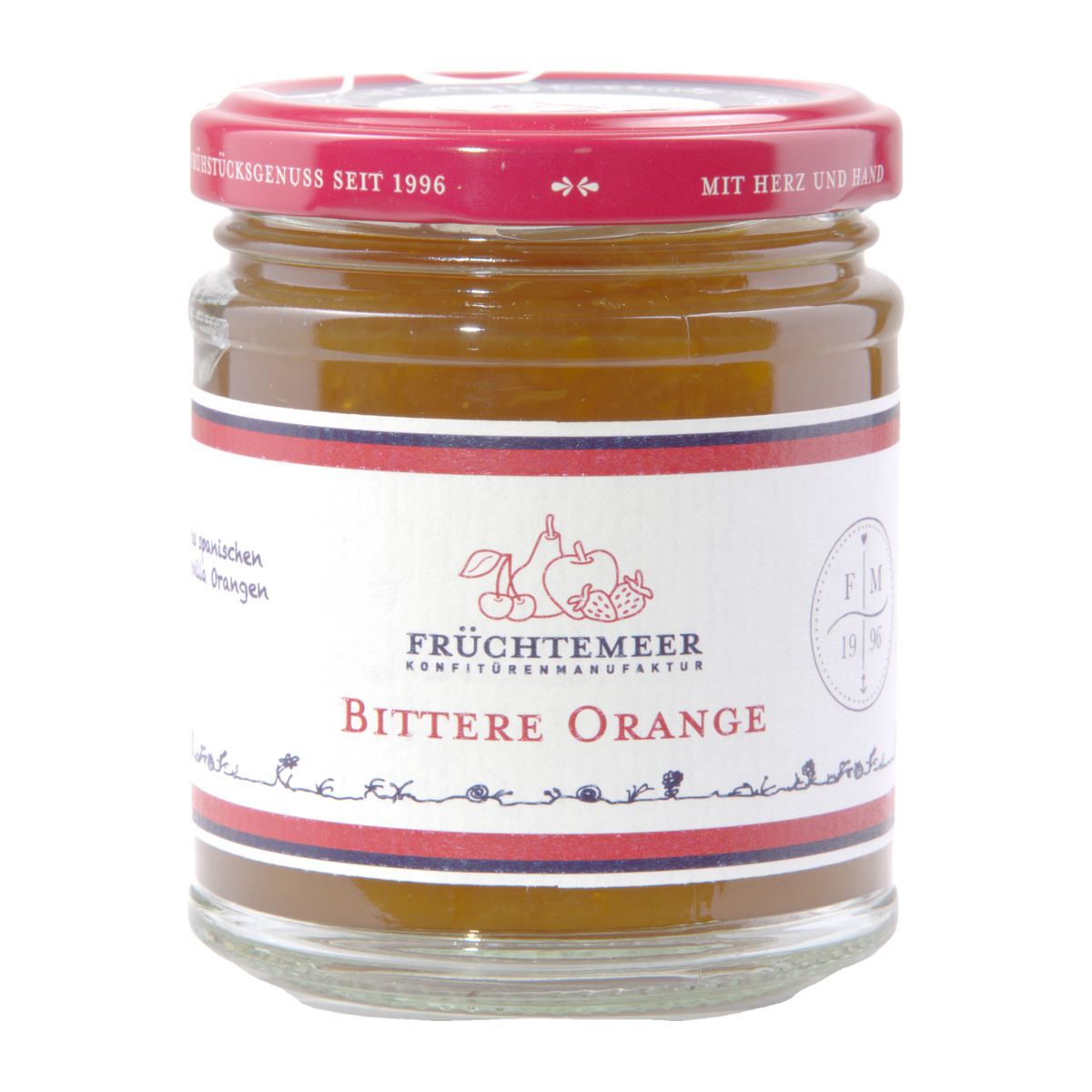
Bitter Orange Fruit Spread
Bitter oranges from Seville with lemon, tart and with no added pectin
Couldn't load pickup availability
- Excellent Ratings
From 250,000 happy customers - Fast Customer Service
by phone, email, or chat - Family-owned since 2002.
genussland.de: where good taste lives.
Shipping & Delivery
Your order will reach you in just 1–2 days for as little as €5.45 with DHL, DPD, or UPS. Shipping is free for orders over €99. Need it faster? Choose from our express shipping options.

Payment and Installment Plan
Your payment information is always processed securely. Choose from many payment methods such as PayPal, Klarna, Apple Pay, Mastercard or Visa and benefit from purchase on account and payment by installments. You can find more information in our Payment Terms.
Bitter Orange Fruit Spread. Seville bitter oranges and lemon, tart and clean on the finish.
Bitter Orange Fruit Spread by FrüchteMeer is made by cooking Seville bitter oranges, lemons, sugar and water, without added pectin or citric acid. No mild orange jam, no children's spread, no orange juice.
Bitter Orange Fruit Spread is a citrus spread from the FrüchteMeer jam manufactory in Wankendorf, made from Spanish bitter oranges and lemons. On British breakfast tables, this type of spread is a staple as orange marmalade. In Germany, many people know it more as a souvenir from a holiday in England. The recipe is simple: four ingredients, about a quarter of which are bitter oranges. Its taste, on the other hand, is multifaceted and anything but simple.
Sweet at the start, bitter in the middle, lemon at the end
The Bitter Orange Fruit Spread unfolds in three stages: first sugary sweetness, then the typical tartness of the bitter orange, and finally a clean citric acidity. The bitter orange, also known as a Seville orange, carries its bitter compounds mainly in the peel and white pith. Its essential oils give the spread a slightly perfumed, spicy aroma.
The lemon keeps the whole thing fresh and ensures a clean finish. Anyone expecting a mild, juicy orange jam will initially find the bitterness too intense. This is why this variety is usually not suitable for children. Anyone who likes espresso, dark chocolate or tart tonics will quickly find a favorite spread here.
The tartness is not a flaw, but the goal of this variety. It is precisely what prevents the spread from tasting sweet and heavy even after several bites.
The difference to orange jam made from sweet oranges is interesting. Sweet oranges provide a lot of juice, but little aroma and almost no bitter compounds. When cooked down, they often taste one-dimensionally sweet. The Seville orange, on the other hand, brings acidity, bitterness and a strong peel aroma all at once. These three layers are the reason why British jam makers have relied on exactly this fruit for generations.
The temperature also changes the impression. When ice-cold from the refrigerator, the bitterness stands out more clearly; at room temperature, the citrus aroma opens up. For the breakfast table, it is recommended to take the jar out fifteen minutes beforehand.
From buttered toast to the Breakfast Martini
Bitter orange pairs exceptionally well with fat, roasted aromas and cocoa, which makes it very versatile in the kitchen. Five ideas:
- For breakfast on crispy toast with salted butter; the saltiness softens the tartness.
- Glaze oven-roasted carrots in the last ten minutes with one tablespoon of spread and a piece of butter.
- Brush a salmon fillet thinly before cooking to create a lightly caramelized crust.
- Swirl two tablespoons into brownie batter for a marbled effect.
- Serve with strong blue cheese on a cheese platter.
A classic of bar culture is the Breakfast Martini: gin, orange liqueur, lemon juice and a bar spoon of orange marmalade are shaken vigorously with ice. With this spread, it turns out particularly tart.
Similarly tart but from the north is the sea buckthorn spread. A tart wild fruit alternative is the rosehip spread from the same manufactory.
Good to know: A little is enough for glazing. One tablespoon is sufficient for a tray of carrots; more lets the bitterness dominate and can easily burn on the edge of the oven.
Seville oranges from Andalusia, cooked in Holstein
The bitter orange, botanically Citrus × aurantium, grows in Seville as a street and garden tree. Its fruits ripen in winter, and the harvest traditionally takes place in January and February. Raw, they are so sour and bitter that they are hardly eaten. A large part of the harvest has therefore gone to the jam kitchens of Great Britain for generations.
Bitter oranges contain a lot of pectin, especially in the peel and seeds. This is why this spread requires no added gelling agent. A side note: under EU law, the term "marmalade" is actually reserved for preparations made from citrus fruits. The everyday term for any kind of fruit spread is therefore, strictly speaking, in the right place with this jar.
It is cooked down in Wankendorf, in the middle of the Holsteinische Schweiz. Karsten Thiesen and Susanne Lucht-Thiesen founded FrüchteMeer as a family business in 1996. They work with traditional methods, like trying new things, and pay attention to the sourcing of their raw materials. For this variety, that means a recipe without additives, in which the fruit sets the tone.
For lovers of tart aromas and English breakfast culture
What sets this spread apart from ordinary orange jam is its deliberate bitterness. It makes it sophisticated, versatile, and an ideal partner for coffee, tea, and dark bread. At the breakfast table, it is the counterpoint to sweet berry varieties.
As a souvenir, the 210-g jar is suitable for people who know orange marmalade from England or like mixing cocktails. Together with a pack of Earl Grey or a bottle of gin, it makes a harmonious gift. Store in the refrigerator after opening.
With Bitter Orange from FrüchteMeer, your breakfast begins with contrast, and in the kitchen you gain a jar that understands tartness as a spice.
FrüchteMeer
FrüchteMeer
Nutritional Information
Nutritional Information
Alcohol content
Alcohol content
Ingredients
Ingredients
Distributor
Distributor
Legal guarantee
Legal guarantee

How it all began
Does this sound familiar? You return from vacation with a bottle of olive oil from Portugal in your suitcase, a jar of fruit spread from South Tyrol, perhaps a bar of chocolate from a small factory in France — and you ask yourself: Why can't I find something like this easily at home? We kept asking ourselves this question.
We are Kerstin and Stephan Uhlenbusch from Nordhorn, a city on the German-Dutch border. On our travels through Europe, we made the most wonderful culinary discoveries: mountain apple juices from the high altitudes of South Tyrol, Breton barrel butter, handmade pasta from Italy, French sea salt. It wasn't the big luxury products that fascinated us, but rather the honest, artisan-made foods from people who put their heart and soul into their products.
In 2002, we decided to turn this passion into our profession: to make good food accessible to everyone who cannot travel to the producers themselves. This is how our gourmet shipping business came into being — initially as a store in Nordhorn, soon after as one of the first gourmet online shops in Germany. Back then under the name nur Gutes (only good things) — today we continue it as genussland.de. The ambition has remained the same: this is where good taste resides.
Who we are
What drives us is the same curiosity with which we started in 2002: finding out who truly makes good food. Over more than two decades, we have built a network — with producers, traders, restaurateurs, and culinary artisans from all over Europe.
Kerstin was the managing director of the association of leading delicatessen merchants in Germany — the industry association of the country's best owner-managed delicatessen stores. In this role, she not only accompanied but actively shaped the German delicatessen industry. With the deli Festival, we also launched our own B2B trade fair for delicacies, which brought together producers, traders, and restaurateurs from all over Europe. The festival no longer exists today — but the relationships that arose from it still accompany us.
What does this mean for you? We know our industry like almost no one else. Chambers of commerce and economic development agencies from all over Europe repeatedly introduce us to exciting producers who want to offer their products on the German market. This way, genussland always offers something you won't find in any supermarket and hardly in any other shop.
What you'll find here
Our assortment includes fine foods, delicacies, wines, non-alcoholic beverages, and selected kitchen and home accessories — from manufacturers in Germany, Austria, Italy, France, Portugal, Spain, England, Iceland, Denmark, Sweden, Greece, and the USA.
An extra virgin olive oil from Portugal, a genuine Aceto Balsamico from Modena, Fleur de Sel from the Breton coast, hand-mixed spice blends. Fruit spreads, aromatic honey, truffle delicacies, chutneys, and mustard sauces. Vintage sardines and fine canned fish, risotto rice, and handmade pasta — basic ingredients for honest cooking and specialties for special moments.
Our fresh delivery service brings the legendary Beurre Bordier from Brittany, Italian Burrata, and fine salami to your home — securely packaged and continuously chilled.
Wine is particularly close to our hearts: white wine from Rheinhessen and the Pfalz, red wine from Austria and Burgenland, rosé for barbecue season, natural wine for the adventurous, sparkling wine and champagne for special moments. Not from all over the world — but from winemakers we have personally visited and whose work we appreciate. Many of them work organically or biodynamically.
Our Philosophy
What makes a product a genussland product? We ask ourselves this question for every single item we add to our range. The answer is never one-dimensional – it's the combination of craftsmanship, origin, ingredients, and the people behind them.
We ask many questions before a product finds its way into our shop. How is it made? Where do the raw materials come from? What philosophy does the manufacturer pursue? We quickly notice whether we are hearing marketing clichés or if a producer is happy to explain their journey. It is precisely this enthusiasm that we seek – and repeatedly find.
Craftsmanship. We prefer products from small manufactories and family businesses that often produce their culinary treasures by hand for generations. The careful processing and artisanal skill can be tasted in every bite.
Best Ingredients. For us, good quality begins with the raw materials. Whether it's fruit, vegetables, milk, meat, or grain – we ensure that our manufacturers rely on first-class, as natural as possible, ingredients. Many of our producers are organically certified; our shop itself is organically controlled under the number DE-ÖKO-037.
Origin and Regionality. We appreciate products with a clear regional identity. A South Tyrolean mountain apple juice made from slowly ripened, old apple varieties. A Portuguese olive oil from trees that have shaped the landscape for centuries. These stories of origin make delicacies what they are.
Personal relationship with the manufacturer. We have known many of our suppliers personally for years, some for over two decades. We visit them, taste together, and exchange ideas. This proximity guarantees transparency and trust.
At the end of the day, it has to taste good. We try all products ourselves – not just once, but again and again while cooking, at the table, on the plate. Only what convinces us personally finds its way into the shop.
The people behind the products
What brings us the most joy: We get to accompany passionate individuals on their journey. People whose drive it is to make a good product even better. Some have been with us since our founding - for over twenty years.
There's the South Tyrolean fruit farmer who presses mountain apple juice from old, slowly ripened apple varieties, unlike anything else. The Italian balsamic family who ages their vinegar in Modena for decades. The Breton butter manufactory whose hand-churned butter is on the menu of the best restaurants in Europe. The Danish licorice pioneer who reinvented a centuries-old specialty.
Behind every product in our shop stands a person, a family, a story. And it is precisely these stories that make the difference between an interchangeable food item and a true delicacy.
This is where good taste resides
Whether you want to order fine foods online, are looking for a special wine, want to put together a gift for a loved one, or simply want to enrich your kitchen with high-quality ingredients — genussland is the right place for you.
Browse through our assortment, get inspired, and conveniently order your favorite products to your home. Read more about our approach on the Sustainability and Responsibility page. Do you have a question? We look forward to your message to our Customer Service.
Welcome to genussland.
Kerstin and Stephan Uhlenbusch

-
 NewVendor:FrüchteMeer
Strawberry Fruit Spread
Strawberries from Schleswig-Holstein, pure-bred and preserved
6 in stockRegular price 5,25€Sale price 5,25€ Regular priceUnit price per -
 NewVendor:FrüchteMeer
Elderflower Jelly Spread
Homemade elderflower infusion in orchard apple juice
6 in stockRegular price 5,25€Sale price 5,25€ Regular priceUnit price per -
 NewVendor:FrüchteMeer
Rum Top Fruit Jam
Raspberry, strawberry and cherry with Jamaican rum
6 in stockRegular price 5,25€Sale price 5,25€ Regular priceUnit price per -
 NewVendor:FrüchteMeer
Sea buckthorn fruit spread
Tart and tangy, made from pressed sea buckthorn pulp
5 in stockRegular price 5,25€Sale price 5,25€ Regular priceUnit price per -
 NewVendor:FrüchteMeer
Bitter Orange Fruit Spread
Bitter oranges from Seville with lemon, tart and with no added pectin
6 in stockRegular price 5,25€Sale price 5,25€ Regular priceUnit price per -
 Sold outVendor:FrüchteMeer
Rosehip Fruit Spread
Smooth rosehip purée, fruity and tart, and seedless
Regular price 5,25€Sale price 5,25€ Regular priceUnit price per -
 NewVendor:FrüchteMeer
Quince fruit spread
Made from our own quinces, smooth and with no added gelling agent
6 in stockRegular price 5,25€Sale price 5,25€ Regular priceUnit price per -
 NewVendor:FrüchteMeer
Cherry-Marzipan Fruit Spread
Sour cherry with Lübeck marzipan, fruity and almond-soft
6 in stockRegular price 5,95€Sale price 5,95€ Regular priceUnit price per -
 NewVendor:FrüchteMeer
Cherry-Vanilla-Rum Fruit Spread
50% Sour Cherries with Bourbon Vanilla and Jamaican Rum
6 in stockRegular price 5,95€Sale price 5,95€ Regular priceUnit price per -
 NewVendor:FrüchteMeer
Pear-Quince Fruit Spread
Pear and quince juice from our own garden, mild and floral
6 in stockRegular price 5,25€Sale price 5,25€ Regular priceUnit price per -
 NewVendor:FrüchteMeer
Blackthorn jelly spread
Clear jelly made from 49% blackcurrant juice, tart and aromatic
6 in stockRegular price 5,25€Sale price 5,25€ Regular priceUnit price per -
 NewVendor:FrüchteMeer
Strawberry-Rhubarb Fruit Spread
25% strawberries and 25% rhubarb from Schleswig-Holstein each
6 in stockRegular price 5,25€Sale price 5,25€ Regular priceUnit price per -
 NewVendor:FrüchteMeer
Cinnamon Magic Fruit Spread – Sour Cherry, Apple & Cinnamon
Sauerkirsche und Apfel zu gleichen Teilen mit Ceylon-Zimt, alkoholfrei
5 in stockRegular price 6,15€Sale price 6,15€ Regular priceUnit price per -
 NewVendor:FrüchteMeer
Glowing Cherry Magic Fruit Spread – Sour Cherry, Red Wine & Rum
Sour cherry with red wine, Jamaican rum and mulled wine spices
6 in stockRegular price 6,15€Sale price 6,15€ Regular priceUnit price per -
 NewVendor:FrüchteMeer
Christmas Breakfast Fruit Spread – Strawberry, Almond & Cinnamon
50% strawberries with almonds and a hint of Ceylon cinnamon
5 in stockRegular price 5,95€Sale price 5,95€ Regular priceUnit price per -
 NewVendor:FrüchteMeer
Baked Apple Fruit Spread
Äpfel mit Mandeln, Rosinen und Ceylon-Zimt aus der Weihnachts-Edition
6 in stockRegular price 5,95€Sale price 5,95€ Regular priceUnit price per


