

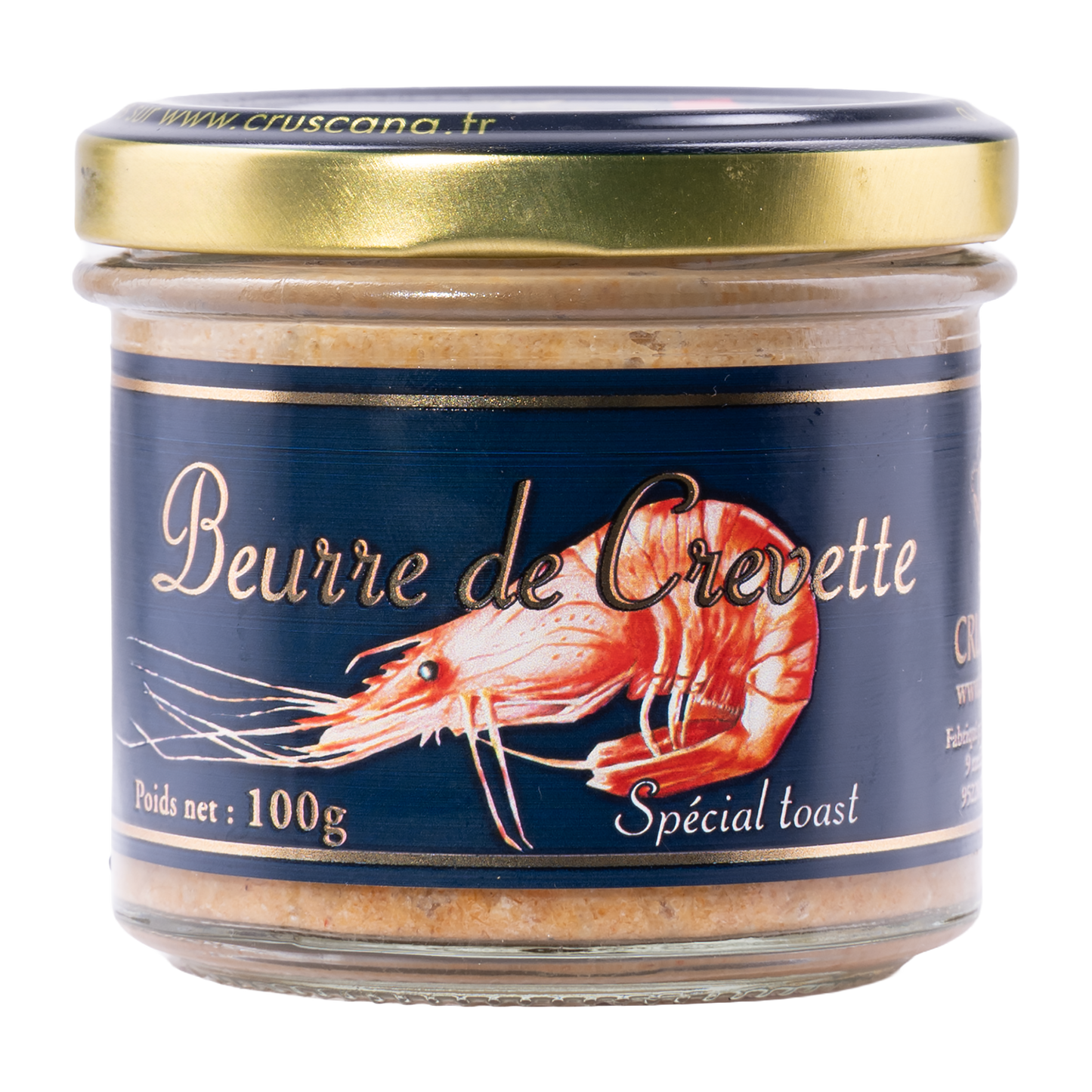
Shrimp butter
Fine cream of North Sea shrimp with cayenne
Couldn't load pickup availability


- Excellent Ratings
From 250,000 happy customers - Fast Customer Service
by phone, email, or chat - Family-owned since 2002.
genussland.de: where good taste lives.
Shipping & Delivery
Your order will reach you in just 1–2 days for as little as €5.45 with DHL, DPD, or UPS. Shipping is free for orders over €99. Need it faster? Choose from our express shipping options.

Payment and Installment Plan
Your payment information is always processed securely. Choose from many payment methods such as PayPal, Klarna, Apple Pay, Mastercard or Visa and benefit from purchase on account and payment by installments. You can find more information in our Payment Terms.
Cruscana Shrimp Butter. North Sea shrimp, cayenne, and the classic French cut.
Shrimp butter is a French shellfish cream made from cold-water shrimp, milk, and butter, produced in Herblay near Paris. No farmed shrimp from the tropics, no shrimp salad, no paste with shellfish flavor.
Shrimp butter is a spreadable shellfish cream from the Cruscana manufacturer, made from 28 percent North Sea shrimp, milk, and 14 percent butter. If you want to make it yourself, you'll need shrimp shells, a mortar, a fine sieve, and a good hour. Afterwards, you'll have four tablespoons of cream and a kitchen full of shells. This jar takes exactly this step off your hands, in the quality for which it was intended.
Fine, creamy, and a lingering cayenne
The shrimp butter is delicately rosé and the finest of the four Cruscana creams. Its aroma is subtle, significantly more delicate than the lobster version. It only truly unfolds on the palate.
First comes the slight sweetness that cooked cold-water shrimp bring. Then follows a creamy richness of butter and milk that coats the mouth. Right at the end, the cayenne announces itself, more as warmth in the throat than as spiciness.
It is the only one in the range that contains mustard, paprika, and cayenne simultaneously. That sounds like a lot, but it's a necessity. Shrimp meat is finer than lobster or crab and would otherwise be lost in the butter.
At 182 calories per 100 grams, it is also the lightest of the four. The salt content, at 1.30 grams, is also at the lower end. You don't notice either of these when eating, but you do when comparing it to its siblings.
Straight from the refrigerator, it is firm and seems closed. Ten minutes at room temperature are enough for the aromas to open up. At about 14 degrees, it reaches the consistency at which it is best spread.
If you expect strong spiciness, you should look elsewhere. The cayenne here is intended as a base, not an effect. This cream is not on a chili level.
From canapés to bisque
It's made for canapés, and that's where its delicacy shines. Take crustless white bread, spread it thinly, and top it with half a shrimp or a sprig of dill. A scant teaspoon is enough for two bites.
In a bisque, a heaped tablespoon replaces the entire final step. Stir it in after turning off the heat, and the soup will thicken and gain a shellfish note at the same time. The same works for a sauce with seafood pasta.
It also works as a filling. Mix a teaspoon with the yolk of hard-boiled eggs and refill the halves. For puff pastry sticks, spread it thinly before folding the dough.
On a hot baked potato, it melts into a rosy, shimmering layer. With asparagus in spring, it's an alternative to classic butter sauce, with significantly less effort. And a teaspoon folded into scrambled eggs turns breakfast into an appetizer.
In cold cuisine, it can also be used to make a dip. One part cream to two parts crème fraîche, a squeeze of lemon, and it's done. Serve with chicory leaves or fennel strips instead of the usual vegetable sticks.
To drink, a dry white wine with a clear structure, such as a Riesling Kabinett, pairs well. A Crémant works just as well because the perlage breaks up the butter film. A cool, not too hoppy beer is the underrated option.
From experience: Spread sparingly. A too thickly applied dollop goes from fine to greasy, and that's the most common mistake with this variety. The cream goes further than it appears.
A recipe from the repertoire of haute cuisine
Beurre de crevette is one of the classic compound butters of French cuisine. Auguste Escoffier described it in the late 19th century as a tool, not a spread. Its purpose was to give a sauce aroma and binding at the last moment.
In 1965, Denise and Gilbert Jouneau adopted this principle. In their suburban pavilion near Paris, they stirred shellfish butter according to Escoffier's model and quickly found customers. In 1981, they passed the business on to the Danish importer Knud Hays Thøgersen, on the condition that the recipes remained.
Since 1980, the manufactory has been located in Herblay in Val-d'Oise, northwest of Paris on the Seine. Around twenty employees work there on 2,200 square meters on three production lines. The business operates under the regional origin label of Île-de-France.
Only Pandalus borealis, the North Sea shrimp from the cold North Atlantic, is processed. It grows slowly, remains small, and develops firm, sweet meat. The manufactory stipulates the origin of the raw materials to its suppliers in a specification sheet.
The German names for this shrimp regularly cause confusion. North Sea shrimp, Arctic shrimp, and Greenland shrimp all refer to the same species. What is always meant is the small cold-water shrimp, not the tropical farmed shrimp from aquaculture.
Additionally, cod is used as a carrier. Its protein stabilizes the emulsion of milk fat and water so that the cream does not break when heated. Nearly thirty preparations are created in Herblay in total, developed by a chef in the in-house laboratory, without colorants and without added preservatives.
The most accessible of the four Cruscana creams
Within the range, it is the best entry point. It is fine enough not to overwhelm anyone, and flavorful enough not to seem arbitrary. If you want to get to know the series, start here and work your way up.
The path then leads from crab butter with its higher butter content to lobster butter, which is the most pronounced. The smoked salmon butter stands alongside as a mild exception without shellfish.
A practical advantage over freshly prepared shellfish butter is its shelf life before opening. Homemade varieties must be consumed within a few days. The unopened jar, however, easily withstands the waiting period until the next occasion.
The cream is not suitable for storage after opening. Without added preservatives, the opened jar belongs in the refrigerator and should be empty within two days. Unopened, however, it is uncomplicated to store.
A side note: The four varieties are not intensity levels of the same recipe. Each has its own raw material and its own seasoning. Therefore, it is worthwhile to open two jars on the same evening and compare them directly.
As a gift for a dinner party, the jar works better than a bottle of wine. It's unusual, it's immediately usable, and it costs the host no preparation. For a reception with twelve guests, calculate two to three jars.
A classic of French cuisine that eliminates an hour of manual labor – without the result showing it.
Cruscana
Cruscana
Nutritional Information
Nutritional Information
Alcohol content
Alcohol content
Ingredients
Ingredients
Distributor
Distributor
Legal guarantee
Legal guarantee

How it all began
Does this sound familiar? You return from vacation with a bottle of olive oil from Portugal in your suitcase, a jar of fruit spread from South Tyrol, perhaps a bar of chocolate from a small factory in France — and you ask yourself: Why can't I find something like this easily at home? We kept asking ourselves this question.
We are Kerstin and Stephan Uhlenbusch from Nordhorn, a city on the German-Dutch border. On our travels through Europe, we made the most wonderful culinary discoveries: mountain apple juices from the high altitudes of South Tyrol, Breton barrel butter, handmade pasta from Italy, French sea salt. It wasn't the big luxury products that fascinated us, but rather the honest, artisan-made foods from people who put their heart and soul into their products.
In 2002, we decided to turn this passion into our profession: to make good food accessible to everyone who cannot travel to the producers themselves. This is how our gourmet shipping business came into being — initially as a store in Nordhorn, soon after as one of the first gourmet online shops in Germany. Back then under the name nur Gutes (only good things) — today we continue it as genussland.de. The ambition has remained the same: this is where good taste resides.
Who we are
What drives us is the same curiosity with which we started in 2002: finding out who truly makes good food. Over more than two decades, we have built a network — with producers, traders, restaurateurs, and culinary artisans from all over Europe.
Kerstin was the managing director of the association of leading delicatessen merchants in Germany — the industry association of the country's best owner-managed delicatessen stores. In this role, she not only accompanied but actively shaped the German delicatessen industry. With the deli Festival, we also launched our own B2B trade fair for delicacies, which brought together producers, traders, and restaurateurs from all over Europe. The festival no longer exists today — but the relationships that arose from it still accompany us.
What does this mean for you? We know our industry like almost no one else. Chambers of commerce and economic development agencies from all over Europe repeatedly introduce us to exciting producers who want to offer their products on the German market. This way, genussland always offers something you won't find in any supermarket and hardly in any other shop.
What you'll find here
Our assortment includes fine foods, delicacies, wines, non-alcoholic beverages, and selected kitchen and home accessories — from manufacturers in Germany, Austria, Italy, France, Portugal, Spain, England, Iceland, Denmark, Sweden, Greece, and the USA.
An extra virgin olive oil from Portugal, a genuine Aceto Balsamico from Modena, Fleur de Sel from the Breton coast, hand-mixed spice blends. Fruit spreads, aromatic honey, truffle delicacies, chutneys, and mustard sauces. Vintage sardines and fine canned fish, risotto rice, and handmade pasta — basic ingredients for honest cooking and specialties for special moments.
Our fresh delivery service brings the legendary Beurre Bordier from Brittany, Italian Burrata, and fine salami to your home — securely packaged and continuously chilled.
Wine is particularly close to our hearts: white wine from Rheinhessen and the Pfalz, red wine from Austria and Burgenland, rosé for barbecue season, natural wine for the adventurous, sparkling wine and champagne for special moments. Not from all over the world — but from winemakers we have personally visited and whose work we appreciate. Many of them work organically or biodynamically.
Our Philosophy
What makes a product a genussland product? We ask ourselves this question for every single item we add to our range. The answer is never one-dimensional – it's the combination of craftsmanship, origin, ingredients, and the people behind them.
We ask many questions before a product finds its way into our shop. How is it made? Where do the raw materials come from? What philosophy does the manufacturer pursue? We quickly notice whether we are hearing marketing clichés or if a producer is happy to explain their journey. It is precisely this enthusiasm that we seek – and repeatedly find.
Craftsmanship. We prefer products from small manufactories and family businesses that often produce their culinary treasures by hand for generations. The careful processing and artisanal skill can be tasted in every bite.
Best Ingredients. For us, good quality begins with the raw materials. Whether it's fruit, vegetables, milk, meat, or grain – we ensure that our manufacturers rely on first-class, as natural as possible, ingredients. Many of our producers are organically certified; our shop itself is organically controlled under the number DE-ÖKO-037.
Origin and Regionality. We appreciate products with a clear regional identity. A South Tyrolean mountain apple juice made from slowly ripened, old apple varieties. A Portuguese olive oil from trees that have shaped the landscape for centuries. These stories of origin make delicacies what they are.
Personal relationship with the manufacturer. We have known many of our suppliers personally for years, some for over two decades. We visit them, taste together, and exchange ideas. This proximity guarantees transparency and trust.
At the end of the day, it has to taste good. We try all products ourselves – not just once, but again and again while cooking, at the table, on the plate. Only what convinces us personally finds its way into the shop.
The people behind the products
What brings us the most joy: We get to accompany passionate individuals on their journey. People whose drive it is to make a good product even better. Some have been with us since our founding - for over twenty years.
There's the South Tyrolean fruit farmer who presses mountain apple juice from old, slowly ripened apple varieties, unlike anything else. The Italian balsamic family who ages their vinegar in Modena for decades. The Breton butter manufactory whose hand-churned butter is on the menu of the best restaurants in Europe. The Danish licorice pioneer who reinvented a centuries-old specialty.
Behind every product in our shop stands a person, a family, a story. And it is precisely these stories that make the difference between an interchangeable food item and a true delicacy.
This is where good taste resides
Whether you want to order fine foods online, are looking for a special wine, want to put together a gift for a loved one, or simply want to enrich your kitchen with high-quality ingredients — genussland is the right place for you.
Browse through our assortment, get inspired, and conveniently order your favorite products to your home. Read more about our approach on the Sustainability and Responsibility page. Do you have a question? We look forward to your message to our Customer Service.
Welcome to genussland.
Kerstin and Stephan Uhlenbusch


