

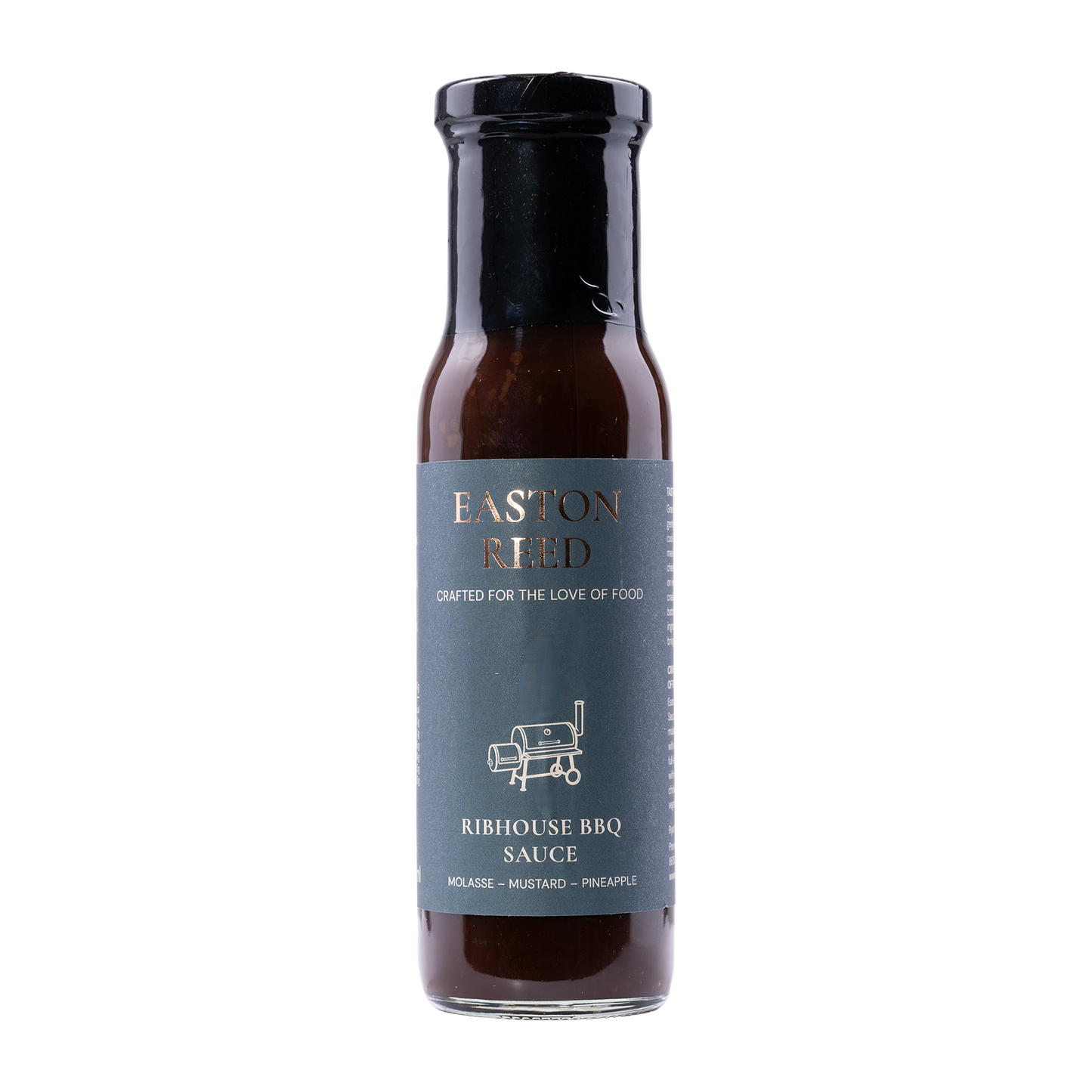
Ribhouse BBQ Sauce
Dark glaze for ribs, with smoke from smoked vinegar
Couldn't load pickup availability
- Excellent Ratings
From 250,000 happy customers - Fast Customer Service
by phone, email, or chat - Family-owned since 2002.
genussland.de: where good taste lives.
Shipping & Delivery
Your order will reach you in just 1–2 days for as little as €5.45 with DHL, DPD, or UPS. Shipping is free for orders over €99. Need it faster? Choose from our express shipping options.

Payment and Installment Plan
Your payment information is always processed securely. Choose from many payment methods such as PayPal, Klarna, Apple Pay, Mastercard or Visa and benefit from purchase on account and payment by installments. You can find more information in our Payment Terms.
Ribhouse BBQ Sauce. Molasses, roasted garlic, and smoke from vinegar.
Ribhouse BBQ Sauce is a dark, thick barbecue sauce from Easton Reed based on brown sugar, tomato paste, and molasses. No smoky flavor from a bottle, no spiciness, no thin tomato ketchup.
Ribhouse BBQ Sauce is Easton Reed's classic barbecue sauce in a 260-milliliter bottle, whose smoky note comes from smoked spirit vinegar. The lid comes off, and the roasted garlic is the first thing that fills the room. Then comes the molasses, dark and almost licorice-like.
If you tip the bottle, you'll notice by the viscous flow that nothing has been watered down here. On a hot grill, the sauce quickly forms a shiny layer that adheres to the meat instead of dripping into the coals.
First sweet, then smoky, finally garlic
The Ribhouse builds its flavor in three steps, and the garlic lingers the longest. First, the molasses works its magic, a warm sweetness with a dark edge that white sugar can't achieve.
Behind it, double-concentrated tomato paste and spirit vinegar provide a counterpoint. This acidity is why the sauce still stimulates the appetite even after the third rib. Four percent pineapple juice concentrate rounds out the edges without making the sauce taste fruity.
Two percent mustard and a proportion of soy sauce provide the savory foundation underneath. You don't taste either of these as a distinct ingredient, but both are immediately missed if they're not there. The texture is syrupy and coating, no comparison to a pourable marinade.
The roasted garlic is the actual aftertaste. A raw garlic note would be pungent here and clash with the sweetness. Roasting shifts the aroma to nutty-caramel and provides a long-lasting base for everything else.
With 42 grams of sugar per 100 grams, the Ribhouse is among the sweeter barbecue sauces. Those looking for a vinegar-heavy Carolina-style sauce will find it too mild. It's also not spicy; there isn't a single chili in the recipe.
Therefore, it's not a standalone solution for those who like it hot. However, it can handle a spoon of chili paste without losing its structure. If you want heat straight from the bottle, you're better off with the Honey Chili Sauce.
On ribs, only in the last ten minutes
The Ribhouse performs best as a glaze, not a marinade. Brush ribs only in the last ten minutes, otherwise the sugar will burn over direct heat and become bitter.
Pulled pork absorbs two to three tablespoons after pulling and binds the dry fibers back together. For burgers, a spoon on the still-hot patty is enough for the sauce to set. Chicken wings go into a bowl after cooking and are tossed with four tablespoons.
Baked potatoes, corn on the cob, and sweet potato wedges can be served with it as a dip, without any further preparation. It also works in a pan if the weather doesn't cooperate on the weekend. In the oven at 180 degrees, it glazes pork belly in the last fifteen minutes.
For a quick weeknight dinner, the ground meat variation is worth it. Sear 400 grams of ground beef. Add three tablespoons of Ribhouse and half a cup of broth, then simmer for ten minutes. On a soft bun, this makes a Sloppy Joe that would otherwise require a whole list of spices.
From experience: One tablespoon of sauce, one tablespoon of apple cider vinegar, and a dash of water make a thinner mopping sauce for long cooking times in the smoker. The same evening becomes fruitier with the Peach Whiskey Sauce, significantly milder with the Honey BBQ Sauce.
Molasses is the dark residue of sugar
Molasses is what remains when crystals are extracted from boiled sugarcane juice. A viscous, almost black syrup that no one wanted for a long time.
In this residue, everything that white sugar loses on its way to becoming a crystal accumulates. Minerals, roasted notes, and a slightly bitter edge. That's precisely why American barbecue kitchens have been reaching for it for generations. What started as a waste product of sugar refining became a fundamental ingredient for an entire family of sauces. It was cheap, too, which was a deciding factor in the 19th-century American South.
Only molasses gives a barbecue sauce its dark color and long aftertaste. Without it, you'd be left with a red tomato sauce with vinegar that's done after two bites. The name Ribhouse refers to American rib houses, where this exact type of sauce is on the table.
At Easton Reed, molasses appears three times in the recipe: in brown sugar, as a distinct ingredient at three percent, and indirectly in invert sugar syrup. The range was developed at Ryan's Specialties in Augsburg, a company that has been bringing American gourmet foods to Germany for over twenty years.
The invert sugar syrup has a technical purpose that you only notice with the second glass. Invert sugar does not crystallize because it is already broken down into fructose and glucose. A sauce with this proportion remains smooth even after weeks in the refrigerator.
Without it, a granular sediment would form at the bottom of the bottle over time. That's why many homemade barbecue sauces feel sandy after a few days. The Ribhouse remains spreadable as long as the bottle is kept cool and dark.
Smoke from vinegar instead of from flavorings
The crucial difference to many barbecue sauces is in the last line of the ingredient list. It states smoked spirit vinegar, not smoke flavoring.
The smoke therefore enters the jar via an ingredient that already brings its own acidity. It doesn't sit on top as a separate note but combines with the vinegar. The result appears rounder and less like a cold campfire.
Liquid smoke in barbecue sauces often overpowers and masks everything else. Smoked vinegar, on the other hand, remains in the background, letting molasses and garlic take the lead. This is precisely what makes the Ribhouse a sauce that can also be spread by the spoonful on a plate.
One limitation remains: The Ribhouse is not a universal sauce for the refrigerator. With fish, light poultry without a crust, and vegetable dishes, its sweetness masks more than it contributes. Its place is with robust meat with roasted aromas.
As a gift for a barbecue invitation, the bottle works better than another side dish. If you want to give the full range, you'll find seven more sauces in the same bottle format in the Easton Reed assortment. Together with two neighboring varieties, this makes a tasting set that will last for several barbecue evenings.
A sauce for all who seek not spiciness in barbecue, but dark sweetness.
Easton Reed
Easton Reed
Nutritional Information
Nutritional Information
Alcohol content
Alcohol content
Ingredients
Ingredients
Distributor
Distributor
Legal guarantee
Legal guarantee

How it all began
Does this sound familiar? You return from vacation with a bottle of olive oil from Portugal in your suitcase, a jar of fruit spread from South Tyrol, perhaps a bar of chocolate from a small factory in France — and you ask yourself: Why can't I find something like this easily at home? We kept asking ourselves this question.
We are Kerstin and Stephan Uhlenbusch from Nordhorn, a city on the German-Dutch border. On our travels through Europe, we made the most wonderful culinary discoveries: mountain apple juices from the high altitudes of South Tyrol, Breton barrel butter, handmade pasta from Italy, French sea salt. It wasn't the big luxury products that fascinated us, but rather the honest, artisan-made foods from people who put their heart and soul into their products.
In 2002, we decided to turn this passion into our profession: to make good food accessible to everyone who cannot travel to the producers themselves. This is how our gourmet shipping business came into being — initially as a store in Nordhorn, soon after as one of the first gourmet online shops in Germany. Back then under the name nur Gutes (only good things) — today we continue it as genussland.de. The ambition has remained the same: this is where good taste resides.
Who we are
What drives us is the same curiosity with which we started in 2002: finding out who truly makes good food. Over more than two decades, we have built a network — with producers, traders, restaurateurs, and culinary artisans from all over Europe.
Kerstin was the managing director of the association of leading delicatessen merchants in Germany — the industry association of the country's best owner-managed delicatessen stores. In this role, she not only accompanied but actively shaped the German delicatessen industry. With the deli Festival, we also launched our own B2B trade fair for delicacies, which brought together producers, traders, and restaurateurs from all over Europe. The festival no longer exists today — but the relationships that arose from it still accompany us.
What does this mean for you? We know our industry like almost no one else. Chambers of commerce and economic development agencies from all over Europe repeatedly introduce us to exciting producers who want to offer their products on the German market. This way, genussland always offers something you won't find in any supermarket and hardly in any other shop.
What you'll find here
Our assortment includes fine foods, delicacies, wines, non-alcoholic beverages, and selected kitchen and home accessories — from manufacturers in Germany, Austria, Italy, France, Portugal, Spain, England, Iceland, Denmark, Sweden, Greece, and the USA.
An extra virgin olive oil from Portugal, a genuine Aceto Balsamico from Modena, Fleur de Sel from the Breton coast, hand-mixed spice blends. Fruit spreads, aromatic honey, truffle delicacies, chutneys, and mustard sauces. Vintage sardines and fine canned fish, risotto rice, and handmade pasta — basic ingredients for honest cooking and specialties for special moments.
Our fresh delivery service brings the legendary Beurre Bordier from Brittany, Italian Burrata, and fine salami to your home — securely packaged and continuously chilled.
Wine is particularly close to our hearts: white wine from Rheinhessen and the Pfalz, red wine from Austria and Burgenland, rosé for barbecue season, natural wine for the adventurous, sparkling wine and champagne for special moments. Not from all over the world — but from winemakers we have personally visited and whose work we appreciate. Many of them work organically or biodynamically.
Our Philosophy
What makes a product a genussland product? We ask ourselves this question for every single item we add to our range. The answer is never one-dimensional – it's the combination of craftsmanship, origin, ingredients, and the people behind them.
We ask many questions before a product finds its way into our shop. How is it made? Where do the raw materials come from? What philosophy does the manufacturer pursue? We quickly notice whether we are hearing marketing clichés or if a producer is happy to explain their journey. It is precisely this enthusiasm that we seek – and repeatedly find.
Craftsmanship. We prefer products from small manufactories and family businesses that often produce their culinary treasures by hand for generations. The careful processing and artisanal skill can be tasted in every bite.
Best Ingredients. For us, good quality begins with the raw materials. Whether it's fruit, vegetables, milk, meat, or grain – we ensure that our manufacturers rely on first-class, as natural as possible, ingredients. Many of our producers are organically certified; our shop itself is organically controlled under the number DE-ÖKO-037.
Origin and Regionality. We appreciate products with a clear regional identity. A South Tyrolean mountain apple juice made from slowly ripened, old apple varieties. A Portuguese olive oil from trees that have shaped the landscape for centuries. These stories of origin make delicacies what they are.
Personal relationship with the manufacturer. We have known many of our suppliers personally for years, some for over two decades. We visit them, taste together, and exchange ideas. This proximity guarantees transparency and trust.
At the end of the day, it has to taste good. We try all products ourselves – not just once, but again and again while cooking, at the table, on the plate. Only what convinces us personally finds its way into the shop.
The people behind the products
What brings us the most joy: We get to accompany passionate individuals on their journey. People whose drive it is to make a good product even better. Some have been with us since our founding - for over twenty years.
There's the South Tyrolean fruit farmer who presses mountain apple juice from old, slowly ripened apple varieties, unlike anything else. The Italian balsamic family who ages their vinegar in Modena for decades. The Breton butter manufactory whose hand-churned butter is on the menu of the best restaurants in Europe. The Danish licorice pioneer who reinvented a centuries-old specialty.
Behind every product in our shop stands a person, a family, a story. And it is precisely these stories that make the difference between an interchangeable food item and a true delicacy.
This is where good taste resides
Whether you want to order fine foods online, are looking for a special wine, want to put together a gift for a loved one, or simply want to enrich your kitchen with high-quality ingredients — genussland is the right place for you.
Browse through our assortment, get inspired, and conveniently order your favorite products to your home. Read more about our approach on the Sustainability and Responsibility page. Do you have a question? We look forward to your message to our Customer Service.
Welcome to genussland.
Kerstin and Stephan Uhlenbusch

-
 NewVendor:Easton Reed
Ginger Teriyaki Sauce
Sweet and savory teriyaki seasoning for wok, pan, and marinades
7 in stockRegular price 9,95€Sale price 9,95€ Regular priceUnit price 38,27€ per l -
 NewVendor:Easton Reed
Honey BBQ Sauce
Milde Grillsauce, in der die Tomate führt und der Honig abrundet
26 in stockRegular price 9,95€Sale price 9,95€ Regular priceUnit price 38,27€ per l -
 NewVendor:Easton Reed
Farmhouse Ketchup
Chunky seasoning ketchup with paprika, cinnamon, and clove
13 in stockRegular price 9,95€Sale price 9,95€ Regular priceUnit price 35,54€ per l -
 NewVendor:Easton Reed
Honey Chili Barbecue Sauce
Süß-scharfe Grillsauce mit mitgekochter Chilipaste statt Pulver
10 in stockRegular price 9,95€Sale price 9,95€ Regular priceUnit price 38,27€ per l -
 NewVendor:Easton Reed
Ribhouse BBQ Sauce
Dark glaze for ribs, with smoke from smoked vinegar
Only 4 leftRegular price 9,95€Sale price 9,95€ Regular priceUnit price 38,27€ per l -
 NewVendor:Easton Reed
Trüffel Ketchup
Truffle ketchup with half the sugar, cold filled
16 in stockRegular price 9,95€Sale price 9,95€ Regular priceUnit price 35,54€ per l -
 NewVendor:Easton Reed
Banana Ketchup
Banana Ketchup with Mango, Tomato, and Mild Curry
15 in stockRegular price 9,95€Sale price 9,95€ Regular priceUnit price 35,54€ per l -
 NewVendor:Easton Reed
Sweet Honey Mustard
Mild Honey-Mustard as a Dip, Dressing, and Glaze
5 in stockRegular price 9,95€Sale price 9,95€ Regular priceUnit price 30,15€ per kg -
 NewVendor:Easton Reed
Raspberry Chipotle Sauce
Raspberry sauce with a smoky note for cheese, turkey, and duck
15 in stockRegular price 9,95€Sale price 9,95€ Regular priceUnit price 38,27€ per l -
 NewVendor:Easton Reed
Raspberry Fine Pairing
Savory Raspberry Chutney with Onion and Balsamic Vinegar
5 in stockRegular price 9,95€Sale price 9,95€ Regular priceUnit price 43,26€ per kg -
 NewVendor:Easton Reed
Cranberry Fine Pairing
Sliceable Cranberry Chutney for Cheese Boards and Roasts
5 in stockRegular price 9,95€Sale price 9,95€ Regular priceUnit price 43,26€ per kg -
 NewVendor:Easton Reed
Maple Chipotle Sauce
Smoky BBQ Sauce with Maple Syrup, Chipotle and a Spoonful of Curry
11 in stockRegular price 9,95€Sale price 9,95€ Regular priceUnit price 38,27€ per l -
 NewVendor:Easton Reed
Apple Onion Fig Sauce
Fig and Onion Sauce for Cheese, Roasted Meats, and Raclette
12 in stockRegular price 9,95€Sale price 9,95€ Regular priceUnit price 38,27€ per l -
 NewVendor:Easton Reed
Gourmet-Ketchup-Trio
Trüffel, Paprika, Banane: drei Ketchups jenseits der Standardflasche
13 in stockRegular price 28,36€Sale price 28,36€ Regular priceUnit price per -
 NewVendor:Easton Reed
Käsebrett-Quartett
Drei Fine Pairings und der Honig-Senf — alles fürs Käsebrett
Only 4 leftRegular price 37,81€Sale price 37,81€ Regular priceUnit price per -
 NewVendor:Easton Reed
Grill-Trio
Rauchig, mild, süß-scharf: die drei Tomaten-Grillsaucen im Set
Only 4 leftRegular price 28,36€Sale price 28,36€ Regular priceUnit price per -
 NewVendor:Easton Reed
Peach Fine Pairing
Mild Peach Chutney with Maple Syrup and Thyme
Only 4 leftRegular price 9,95€Sale price 9,95€ Regular priceUnit price 43,26€ per kg -
 NewVendor:Easton Reed
Peach Whiskey Sauce
Light barbecue sauce, in which the stewed onion supports the peach
7 in stockRegular price 9,95€Sale price 9,95€ Regular priceUnit price 38,27€ per l


